
Stephen Paddock
b. December 1729 Nantucket, MA d. February 1814 Hudson, NY
Revolutionary Service: Loaned money to Continental Government; New York in the Revolution, Cpl., 7th Regt. Dutchess County Militia
___________________________________________________
Nantucket Selectman, Sail Maker, Hudson Proprietor
While serving as a Selectman of Nantucket, Paddock signed a letter in 1775 pleading with the Provincial Congress of Massachusetts to exempt Nantucket from representation in the Continental Government. The letter outlines the specific difficulties of the people of Nantucket:
“Our local situation is peculiar, and our circumstances in several respects different from any other place in America…placed on an Island, detach’d at least Thirty miles from any part of the Continent, whose production is insufficient to support one third part of its Inhabitants with the Necessaries of life, and laying open to any Naval power, to stop all supplies with a small armed force by sea, the only channel by which we can receive them; The Inhabitants are the greater part, of the people call’d Quakers, whose well known principles of Religion, will not admit of their taking up arms in a military way in any case whatever…"
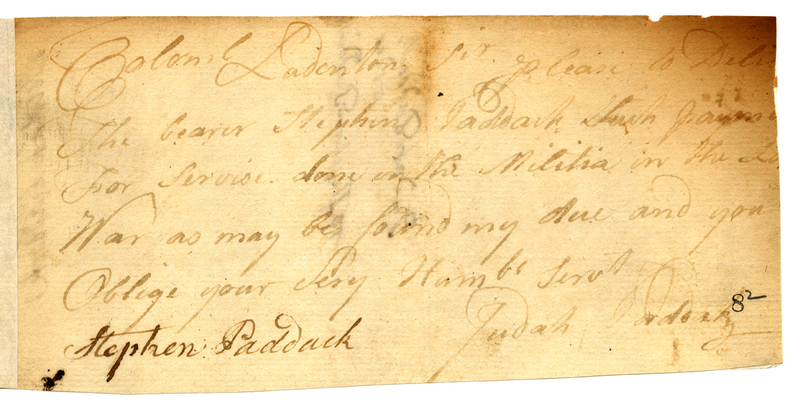
However, at some point during the war Paddock was moved to serve, as this document at right and the document on the wall from the New York State Archives requesting recompense for his service shows.
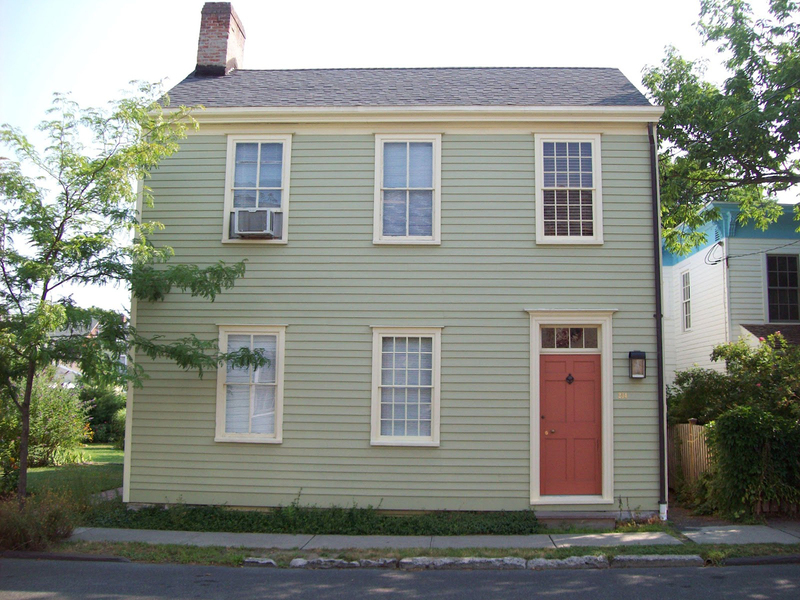
Present day 234 Union Street, an example of a one-over-one side-hall Nantucket with garret extension, built sometime between 1794 & 1808.
After the war, Paddock moved to Claverack Landing, and at the invitation of Colonel John Van Alen, stayed in his home until his own house on Front Street was erected. Later Paddock built a larger home at First and Warren Streets.
In 1787 Paddock partnered with Seth Jenkins on a sailmaking factory they built on Third Street. They sold sails in New York City and to shipbuilders in Hudson. Paddock also received a license in 1786 "to retail all kinds of spirituous liquors".
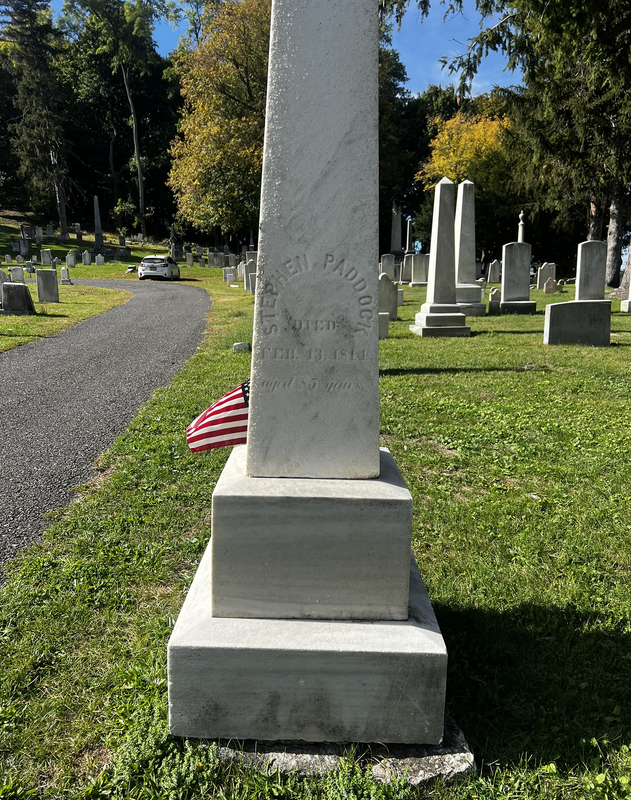
Stephen Paddock’s Grave,
Section 1/2B, Hudson Cemetery
He was treasurer of the Hudson Aqueduct Company, a project that began in 1785 to develop a water system with wooden pipes in the city. On behalf of the association, he purchased land with rights to both the Ten Broeck Spring and the Hyuck’s Spring, later known as Hudson Fountain. Jasper Danckaerts, visiting the colonies in the late 1600s wrote of the springs: ”Large clear fountains flow out of these cliffs or hills; the first real fountains, and the only ones, we have met in this country.” Paddock served as alderman 1785-1792 and 1795-1796. He also served in county government as Supervisor and Moderator for Hudson, and as moderator in 1810 when the Proprietors’ Organization was dissolved.
__________________________________________
Additional Resources:
“Paddock Family Brought First Pre-Fabricated House to City” (Links to PDF)
Walter. V. Miller, Columbia County Historian. Register-Star, July 9, 1964.
Roster listing Salary due to Stephen Paddock during the war (Links to PDF)
Paddock is owed 39 pounds 9 shilling and 7 pence for his service on November 3, 1778.
Abstract from the Revolutionary War Accounts and Claims (Series A0200), from New York in the Revolution as Colony and State, 3d ed., 2 vols. (Albany: 1904).