
Thomas Jenkins: Revolutionary and Hudson Proprietor
Nantucket relied almost exclusively on trade, receiving food and supplies from ships and getting income from seafaring voyages. Far from the mainland, the island was a harrowing place during the Revolution and its ships were prone to assault from privateers.
Seth Jenkins and others tried to convince both Britain and the Continental Government that Nantucket whale ships should be given certificates of passage because of the pacifist stance of their Quaker owners and shipmasters. However, because of these diplomatic interactions Nantucketers were sometimes accused of treason. And, indeed, though a majority were Quaker and pacifists, some people of the island had loyalist sympathies and some had revolutionary sympathies, with a few even fighting in the war.
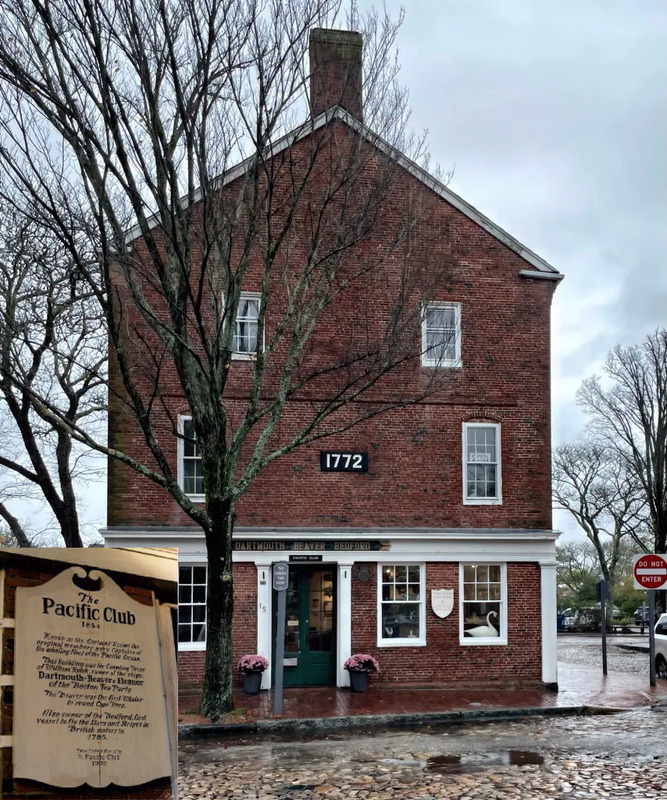
The Rotch Counting House, Main Street, Nantucket with inset of plaque on front of building.
Originally from Nantucket and maintaining business interests there, Thomas Jenkins settled in Providence and became a wealthy maritime merchant trading in goods from the West Indies to London and various ports in eastern North America. During the war, his Nantucket storehouse was pillaged by British ships. Jenkins believed William Rotch, a Nantucketer and wealthy merchant, had facilitated the robbery and then discouraged a fleet of vessels from pursuing the British ship that had the contraband. Jenkins accused Rotch of high treason before the Supreme Legislature of the State of Massachusetts. Rotch was subsequently found not guilty.
“...said [British] Officers with a number of his people proceeded immediately to some Ware houses of your Complainant, and robbed him of — 260 barrels of Sperm Oil, 1800 lbs of Whale Bone, 2300 wt. of Iron, 1200 lbs of Coffee, 20,000 wt of Tobacco, and a number of smaller articles, all of which they carried off, together with a Brig,”
At the end of the war Nantucket loyalists established whaling communities in Nova Scotia and elsewhere. The Rotch family established a whaling community in Dunkirk, France. Jenkins and the Hudson proprietors clearly threw their lot in with the new revolutionary country as they found a safe harbor in the Hudson Valley.
__________________________________________
Additional Resources:
Copy of Thomas Jenkins Complaint, November 1779 (Links to PDF)
Complaint by Thomas Jenkins charging William Rotch with high treason. Jenkins accused Rotch of encouraging a British contingency to come to Nantucket and then abetted their raid on Jenkins’ warehouse where they confiscated his goods. Jenkins further charged that Rotch and others dissuaded local seamen from pursuing the British ship loaded with the stolen property. Finally he accuses Rotch and other loyalists of going to a British port to meet with the Enemy, which the Continental government had made illegal during the war.
From The Rotches, by John M. Bullared. Printed by W. B. and A. B. Rotch The Cabinet Press. Milford, New Hampshire, 1947.
Two Acts of Congress Giving Thomas Jenkins and Company Relief for Damages and Loss on Two of his Ships (Links to PDF)
Privateers were privately owned ships authorized by the Continental Congress, which had only a small navy of its own, to harass and seize British vessels. In these two Acts of Congress we see that Jenkins was twice awarded damages for incidents with his ships. Perhaps these were damages from wartime activity?
“Chap. XX. - An Act for the relief of Thomas Jenkins and Company” Approved, June 14, 1790 and “Chap. III. - An Act for the relief of Thomas Jenkins and Sons,” February 12-April 18, 1794, The Public Statutes at Large of the United States of America from the Organization of the Government in 1789 to March 3, 1845.