
Choosing the Path of Survival
For the Hudson Valley's American Indian Nations, the outcome of the American Revolution would determine their survival as a sovereign peoples.
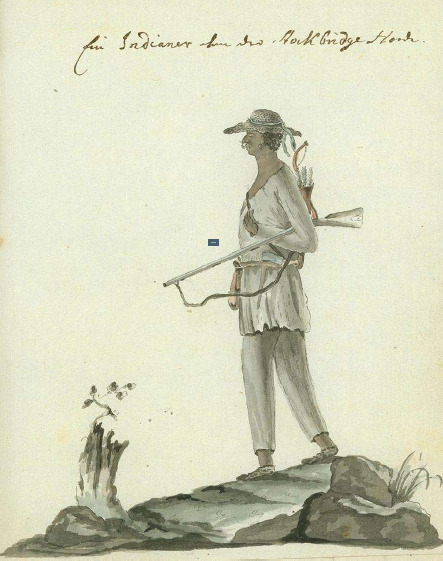
A Stockbridge Indian Militiaman in 1778
Watercolor by Hessian officer Johann von Ewald
Harvey A. Andruss Library
Bloomsburg University of Pennsylvania
In 1776, on the eve of the American Revolution, Columbia County’s Mohican Nation had already been dispossessed of their ancestral lands. And like their settler neighbors, the brewing conflict divided them along ideological lines. Three decades earlier, approximately half of the Mohican Nation had moved to a Christian mission in Stockbridge, MA. There, they formally transferred their Council Fire (seat of government) from its original location on the Hudson River islands of Schodack. In Stockbridge, the Mohican Nation maintained their language and sovereignty as an American Indian Nation while learning to adapt to Euro-American society. In contrast, for those Mohicans who wished to maintain a traditional way of life, the upper Susquehanna River offered a place of refuge in the 1740-1778 period.
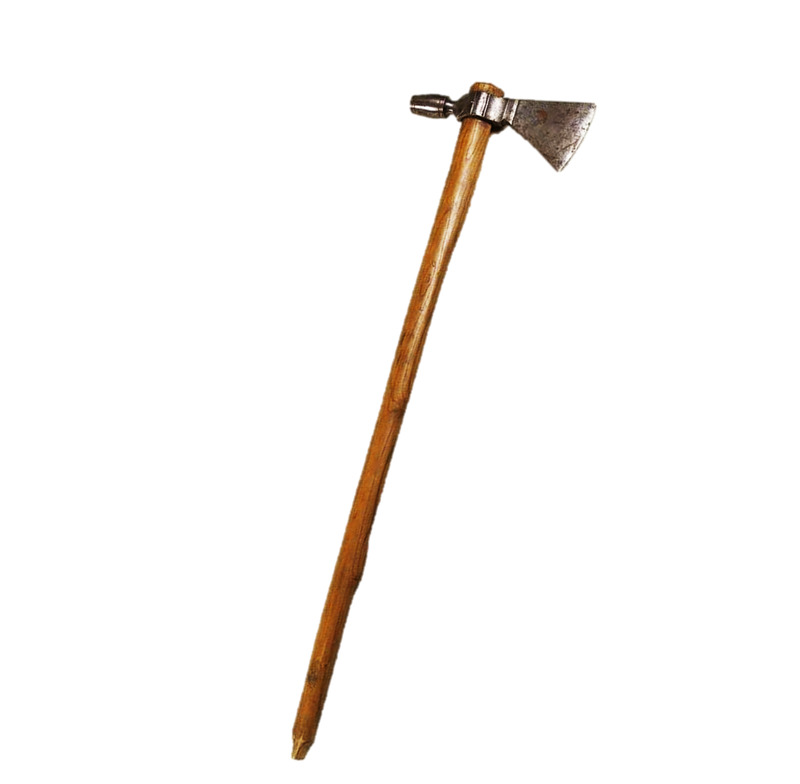
Pipe Tomahawk
belonging to Stockbridge Mohican
Joseph Jourdain (ca. 1830)
National Museum of the American Indian, 1/2131
As early as 1775, the Stockbridge Mohicans showed that they were the most fervent supporters of Revolution among the region’s American Indian Nations. Stockbridge Indian warriors served in the battles of Bunker Hill (1775), White Plains (1776), Bennington (1777), and Kingsbridge (1778). They also provided scouts in the Philadelphia Campaign (1777) and in the Clinton-Sullivan Expedition (1779) that destroyed nearly every town in the country of the Six Nations. As the war progressed, they made huge sacrifices. In one battle alone — the Battle of Kingsbridge in the Bronx (August 31st, 1778) — close to half of the Stockbridge Mohican Nation’s adult male population was killed. When the Americans emerged victorious, their loyal Stockbridge Mohican allies found themselves once more dispossessed, as their town of Stockbridge had been taken over by settlers. By the mid-19th century, the Stockbridge Mohican Nation had settled in Wisconsin. Today, they are known as the Stockbridge-Munsee Band of Mohican Indians.
“Brothers appointed by the Twelve United Colonies:
Depend upon it, we are true to you, and mean to join you.
Wherever you go, we will be by your sides. Our bones shall lie with yours.
We are determined never to be at peace with the red coats,
while they are at variance with you…
If we are conquered, our lands go with yours; but if we are victorious, we hope you will help us to recover our just rights.”
Captain Solomon, Chief of the Stockbridge Indians in Council at Albany (September 1st, 1775)
Schuyler Indian Papers. New York Public Library, MssCol 2701
