War Ending
The Treaty of Paris was signed September 3, 1783, but Roelof and Solomon’s future was still unclear. On September 29, Roelof wrote to one of his sons that he and Solomon had been moved to a private home on the east side of the Hudson, a place known at the time by the Indigenous name Acquackanock (today’s Passaic, New Jersey). He wrote “so that if any of my Friends Wants to See me Come here. Because I See no Probibillyty [sic] as yet to see them With Saifty [sic].”[1]
In December Roelof wrote to Maria from Acquackanock in the letter mentioned earlier, saying he could not advise her about when to come or when he might return home:
… I expected I Would not Be able to Come home
as Soon as I had Expected, on account of the Definitive treaty
not Being Published By authority, and not know as yet weather [sic]
the assembly have made a house or not, or Weather they Will or
Can Do anything for us …
I am at a Loss at
Present What to advise you about Comeing [sic] to see me.[2]
The letter clearly reflects the strain Roelof must have felt at the time, anxious to be home again, with the war and his imprisonment behind him, yet still in limbo. The family had been separated for the better part of seven years. But the postscript of the letter between husband and wife reveals a remarkable personal detail about brother Solomon that may apply uniquely to him or may expose a fashion choice among men of similar standing from New Paltz at the time.

Detail of a hand-colored lithograph showing a peruke or wig. British Museum.
At the end of the letter, Roelof wrote, “P.S. Salomon Desires You Would Bring his Whig or Pruk along or Send it With a Safe hand.” Pruk is indeed the Dutch word for wig, and in this case likely refers to a peruke, a type of wig worn by men in the 18th century. Drawn at the back of the neck with a ribbon and sometimes powdered, such wigs were fashionable among both the British and American men of means and served as a symbol of status and social standing. But did that carry over into rural communities like New Paltz? The letter leaves no doubt that Solomon had a wig and felt a need to have it delivered to him, so was he planning for his future freedom and looking forward to wearing it again? This also suggests that Roelof and other men from the successful families of New Paltz had and wore such wigs at the time. There are no known portraits of New Paltz men from this period, but perhaps other documents will come to light to confirm this theory.
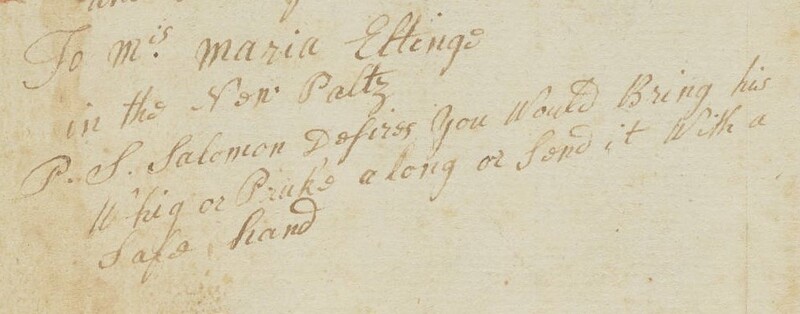
Detail mentioning Solomon’s “whig” from the letter from Roelof Josiah Eltinge to his wife Maria, January 11, 1784. Roelof J. & Ezekiel Elting Family Papers, HHS Archives.
Click image to see the full document.
Finally, on January 14, 1784, the Second Continental Congress of the United States ratified the Treaty of Paris. Still, the Eltinge brothers were not in the clear yet. New York refused to consider recommendations regarding the treatment of Loyalists. Article Six of the Treaty read:
That there shall be no future Con-
fiscations made nor any Prosecutions
commenced against any Person or
Persons for, or by Reason of the Part,
which he or they may have taken
in the present War, and that no Person
shall on that Account suffer any future
Loss or Damage, either in his Person,
Liberty, or Property; and that those
who may be in Confinement on such
Charges at the Time of the Ratification
of the Treaty in America shall be
immediately set at Liberty, and the
Prosecutions so commenced be
discontinued.[3]
Roelof and Solomon’s release was up in the air, but perhaps they were holding on to hope. Just as Solomon requested his wig be sent to him, Roelof may also have been thinking ahead and preparing for the future. On January 18, an effort was made to return the watch mentioned earlier, which had apparently been taken from Roelof (perhaps for safekeeping) near the start of his confinement back in New Hampshire in 1777. The entry in his diary for January 19, 1784 reads:
I Received a Watch
of Abraham Joralemon Which he Said he
had Received from Peeter Eltinge for me
But By Examining I Fiend [sic] it not to
be my Watch.[4]
The fact that the watch didn’t belong to him must have been disappointing for Roelof. Still, the brothers remained positive and proactive. On February 12, Roelof and Solomon drafted a petition to the New York State Legislature. Written in Roelof’s hand, their plea to return home read as follows:
... Your Petitioners have been upwards
of five years under Banishment from thir[sic] Families not with
standing which neither of them have born Arms or taken
any active Part in the War. That Articles of Peace having
been concluded, and Ratified ... Your
Petitioners ar [sic] Absolved from any Allegiance to the King
of Great Britain, and are by the Treaty intitled to become
Citizens of the State; they therefor hope no objections
will now remain to their being released from the disa
greable [sic] situation to which they have been So long exposed ...[5]
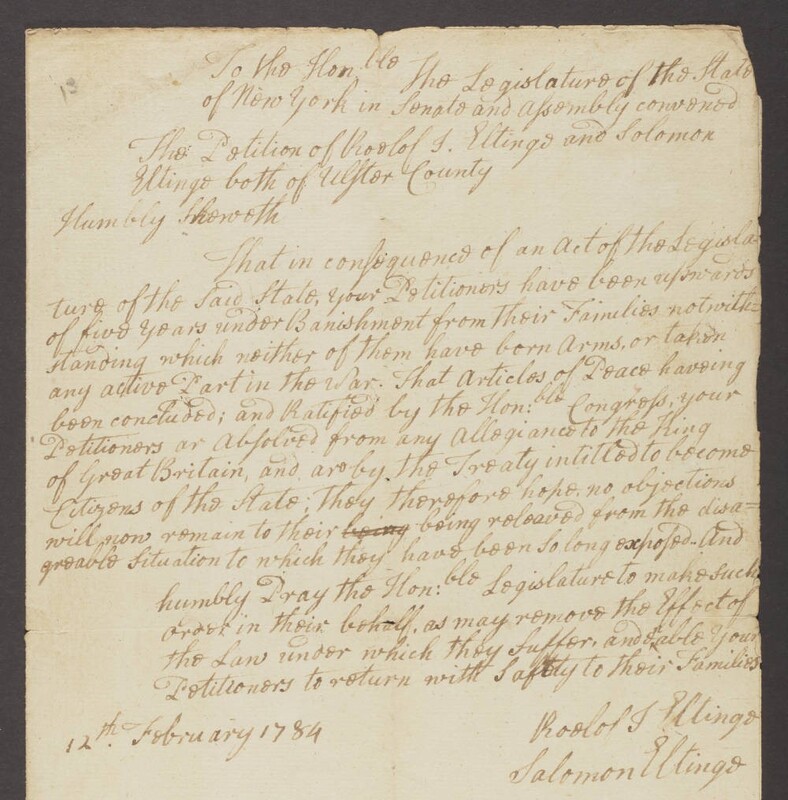
Petition to the New York State Legislature, February 12, 1784. R oelof J. & Ezekiel Elting Family Papers, HHS Archives.
Click image for more information.
Their petition, and those of others, would be rejected by the New York Assembly, while the State Senate voted to postpone consideration.[6] However, Roelof was still plotting his return home and making plans to fund the restocking of his store. On February 26, Roelof wrote and signed two promissory notes, one for a loan of 300 pounds from his father, Josiah, and another for a loan of 200 pounds from his brother Cornelius. The terms of the loans were such that if Roelof paid each man (or his heirs) half of the respective loan amounts plus interest within one year, the loan would be considered paid off. While this may seem generous and suggests that Josiah and Cornelius wanted to help Roelof get back on his feet, the language and terms of these notes were not uncommon for the period. The notes were witnessed by Solomon and their eldest brother Abraham, who likely made the trip to see his two brothers in New Jersey.[7]
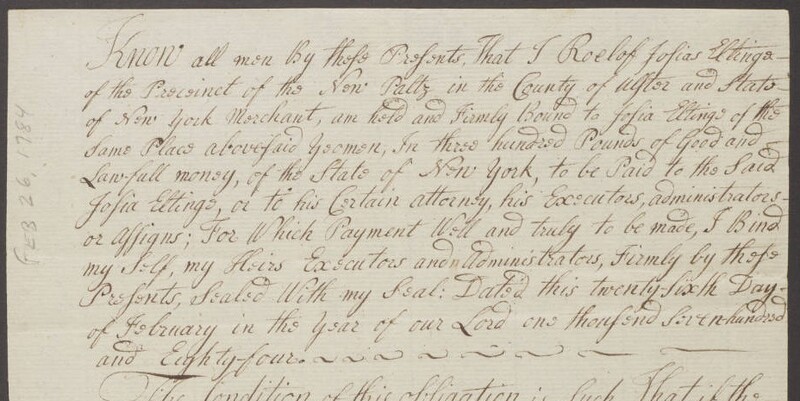
Promissory note, payable to Josiah Elting, February 26, 1784. Roelof J. & Ezekiel Elting Family Papers, HHS Archives.
Click image to see the full document.
Notes
[1] Letter, Roelof Josiah Eltinge to his “Loving Son,” September 29, 1783. Elting Papers, HHS Archives, https://nyheritage.contentdm.oclc.org/digital/collection/p16694coll153/id/9275/rec/76.
[2] Letter, Roelof Josiah Eltinge to his wife Maria Louw Eltinge, January 11, 1784, cited earlier, https://nyheritage.contentdm.oclc.org/digital/collection/p16694coll153/id/4469/rec/96.
[3] “Treaty of Paris (1783),” The U.S. National Archives and Records Administration website, accessed June 15, 2026, https://www.archives.gov/milestone-documents/treaty-of-paris.
[4] Roelof Josiah Eltinge’s Diary and Account Book (page 13), https://nyheritage.contentdm.oclc.org/digital/collection/p16694coll153/id/6378/rec/76.
[5] Petition to the New York State Legislature, February 12, 1784. Elting Papers, HHS Archives, https://nyheritage.contentdm.oclc.org/digital/collection/p16694coll153/id/9260/rec/80
[6] Shefsiek, “Suspected Loyalist,” 42.
[7] Promissory notes payable to Josiah Eltinge and Cornelius Eltinge by Roelof Josiah Eltinge, both dated February 26, 1784. Elting Papers, HHS Archives, https://nyheritage.contentdm.oclc.org/digital/collection/p16694coll153/id/4465/rec/79 and https://nyheritage.contentdm.oclc.org/digital/collection/p16694coll153/id/6824/rec/80.