Continental Currency
Although they were signers of the Articles of Association, Roelof Josiah and Solomon’s commitment to the Patriots’ cause would soon be tested. To fund the war against the British, the Continental Congress and various colonies issued paper money, and on June 5, 1775 the New York Provincial Congress passed resolutions requiring acceptance of the new currency. Those who refused to cooperate “were to be imprisoned, put under bond for good behavior, or removed from their localities on parole.”[1]
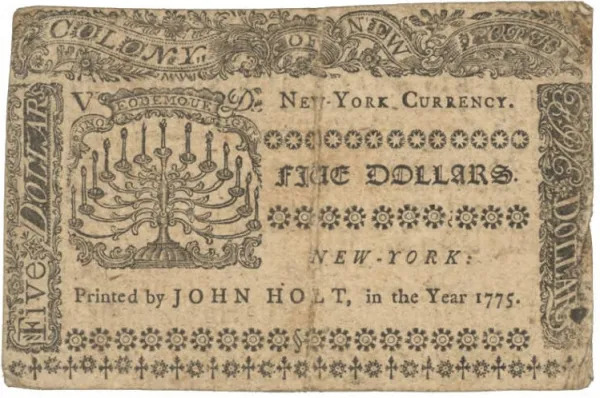
Continental Currency, 1775. HHS Archives.
Although he initially accepted the new currency, Roelof Josiah began doubting it would hold its value. In later testimony, he stated that after Patriot troops retreated from Long Island, “there was a general rumour amongst the people of [the] Neighborhood that in a little time Congress money would be good for nothing as the King was likely to overcome.”[2]
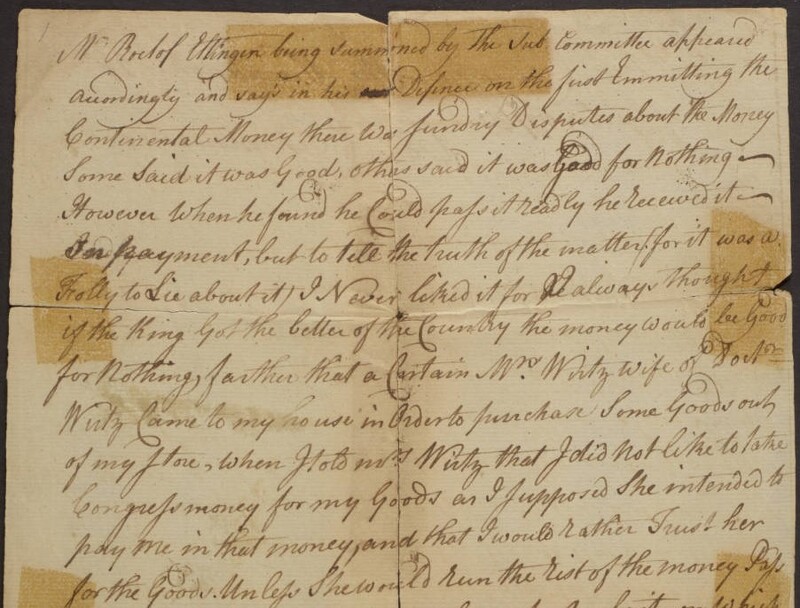
Testimony of Roelof J. Eltinge, October 26, 1776. Roelof J. & Ezekiel Elting Family Papers, HHS Archives.
Click image to see the full document.
One day thereafter, Roelof Josiah refused to accept Continental currency for goods purchased at his store by Esther Hasbrouck Wirtz (sometimes Wurtz or Wurts), offering her credit instead. Subsequently, on October 26, 1776, Roelof was brought before the Ulster County Committee of Safety, which was charged with the suppression of Loyalists. The Committee met at the home of Ann (Huey) DuBois, the widow of Philip DuBois. Ann had continued operating her husband’s tavern at their home west of the Wallkill River after his death in 1767. The tavern was the site of many such meetings in the midst of the growing conflict between the American Patriots and the British, likely contributing to that area of what was then New Paltz becoming known as “Libertyville.” [3]
While refusing the new currency would have been enough to brand Roelof Josiah and Solomon as Loyalists, a long-standing family feud has been thought by some to have contributed to their troubles. A dispute in 1748 began over a land grant made to Noah Eltinge (Roelof Josiah’s uncle) and Nathaniel LeFevre for 3,000 acres, lying on both sides of the Wallkill River. Abraham Hasbrouck of Kingston, Louis Bevier of Marbletown, and Jacob Hasbrouck Jr., acting on behalf of descendants of the New Paltz patentees, alleged that part of the tract was covered by the original New Paltz patent. They also claimed that Noah had no good title to the homestead his father Roelof Eltinge the elder purchased from his DuBois uncles-in-law in 1726. Supposedly, the matter was settled out of court, with Noah Eltinge and Nathaniel LeFevre retaining their 3,000 acres and Noah the homestead property, with Abraham Hasbrouck, Jacob Hasbrouck Jr. and Louis Bevier apparently acquiring 2,000 acres south of the New Paltz patent in what is now Clintondale.[4]
As it happened, Esther Hasbrouck Wirtz (the woman whose Continental currency Roelof Josiah denied) was the daughter of Jacob Hasbrouck Jr., an instigator of the original land dispute and now a member of the Ulster County Committee of Safety. On October 26, 1776, the committee sentenced Roelof Josiah to prison. His younger brother Solomon was soon found guilty of the same crime.[5]
Notes
[1] Kenneth Shefsiek, “A Suspected Loyalist,” 34, citing Alexander Flick, Loyalism in New York During the American Revolution (1901; New York: Arno Press, 1969), 180–182.
[2] Testimony, Roelof Josiah Eltinge, October 26, 1776. Eltinge Papers, HHS Archives, https://nyheritage.contentdm.oclc.org/digital/collection/p16694coll153/id/20122/rec/54.
[3] Roelof notes the location of the meeting in his Diary and Account Book, 1776–1784 (page 4). Elting Papers, HHS Archives, https://nyheritage.contentdm.oclc.org/digital/collection/p16694coll153/id/6390/rec/1. Regarding Ann (Huey) DuBois, see William Heidgerd, The American Descendants of Chrétien Du Bois of Wicres, France, Part Two, (Du Bois Family Association, 1998), 2. See also pages 5–6 for information concerning meetings attended by Major Lewis DuBois. Carol Johnson, Coordinator of the Haviland-Heidgerd Historical Collection, Elting Memorial Library, shared in a phone conversation with Josephine Bloodgood around February 2025 that she recalled the name Libertyville had associations with events surrounding the American Revolution.
[4] LeFevre, History of New Paltz, 383 and 485. For additional discussions about the feud, see William and Ruth P. Heidgerd, The Elting Family (1989), 14, and Grace Elting Castle, Answering the Cal!: An Elting Military History Tribute (Published by the author, 2008), 208–209.
[5] Shefsiek, “A Suspected Loyalist,” 41.