Political Stance
Sources reveal little about Roelof and Solomon’s true political views. Both brothers signed the Articles of Association, suggesting they initially, at least, supported the Patriot cause. The refusal of Continental currency by Roelof and Solomon during the following year was likely done out of the family’s financial best interest. As Roelof said in his testimony, “I Never liked [the currency] for I always thought if the King got the better of the Country the money would be worth nothing.”[1]
Although the king never did “overcome” the country, Roelof was correct in his skepticism for Continental currency. It became so devalued during the war that it caused families of even faithful Patriots like Zachariah DuBois of Goshen to enter into serious debt. Due to these debts, a judgment was made against Zachariah’s estate after his death in 1783, and his family is said to have been turned “out of house and home.”[2]
The Eltinge family’s leanings in a controversy within the Dutch Reformed Church may indicate a conservative mindset and loyalty to the European countries that had planted colonies in North America. Squabbles in the Dutch Reformed Church that began in the first quarter of the eighteenth century resulted in two factions: the American Coetus and the Conferentie. The American Coetus wanted greater independence from the Classis of Amsterdam (the organization that oversaw the Dutch Reformed Church), including education and ordination in America. The more conservative Conferentie believed that clergy must continue to be educated in Europe and ultimately ordained in Holland.
In the latter half of the 1760s, several New Paltz residents with this more conservative mindset joined a new church organization, referred to as the Second Church, or Owl Church. Among the most supportive members of the new church was the Eltinge family. Josiah Eltinge and his brother Noah Eltinge were two of three men elected to supervise the construction of a church and generously donated to the organization. Roelof, Solomon, and their brother Cornelius joined in 1768. With the help of donations from members, a church building was erected on property provided by Noah Elting, about two miles west of the village, on the west side of the Wallkill River. The Owl Church remained separate from the first Reformed Church in New Paltz until May 25, 1783.[3]
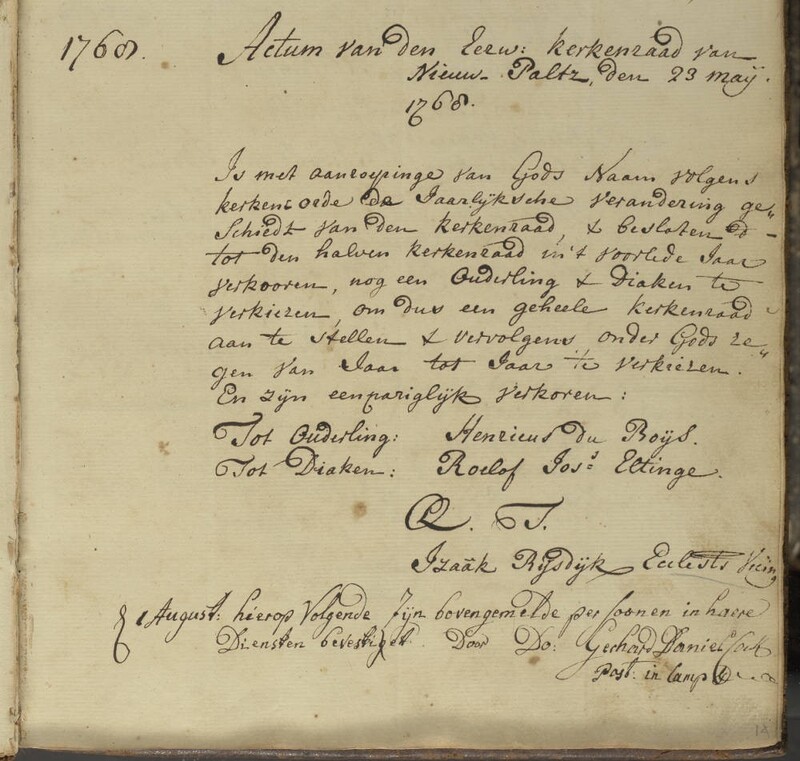
Record naming Hendricus DuBois as Elder and Roelof Josiah Eltinge as Deacon (in Dutch). New Paltz Conferentie Church ("Owl Church") Register [known as Church Register, Volume 4], 1767–1783. Reformed Church of New Paltz.
Click image to see the full volume.
No evidence has been found, however, that either Roelof or Solomon expressed any overt allegiance to the British Crown. Yet, their refusal to sign the oath of allegiance in July 1778 would have made them highly suspicious to the Patriots. What was the sentiment behind making such a serious refusal? Historian Kenneth Shefsiek has proposed (referring specifically to Roelof) that mistreatment by the Patriots—the shuttling from place to place, confinement, etc.–over the previous year and a half resulted in Roelof’s heart being hardened against them and “made it too galling for him to take the oath.” Shefsiek continues:
Thus, it is likely that [Roelof] was a conservative forced into the
Loyalist camp by the harsh treatment to which he was subjected for a
perceived offense that was simply a matter of financial self-preservation.[4]
Solomon probably felt similarly and was also likely committed to standing in solidarity with his elder brother.
In the meantime, after Roelof and Solomon were exiled to New York, Josiah Eltinge and his youngest son Cornelius were listed as suppliers to the Continental Army in a document entitled “Entries of Purchases made by Coenraedt J. Elmendorph. Asst. Commissary of Purchases for the District of the Counties of Ulster and Orange.”[5] While serving as a supplier was probably voluntary at this point in the war, there may have been some expectations of compliance on the part of Patriots in the community. Josiah and Cornelius likely wanted to keep peace with their neighbors. Also, supplying goods was likely profitable and made good business sense during tough economic times. In November 1778, a young Cornelius had been married two years earlier and had already started a family when he supplied 24 barrels of flour and was compensated with just over 357 pounds (being equivalent to about $1,600 today). In May of the following year, he supplied 6 barrels of flour and was compensated just over 186 pounds. In October, Josiah supplied 8 bushels of wheat, earning 64 pounds. This latter amount was more than other farmers in New Paltz, but one-third of the amount of wheat supplied by Cornelius DuBois, who appeared on the next line.
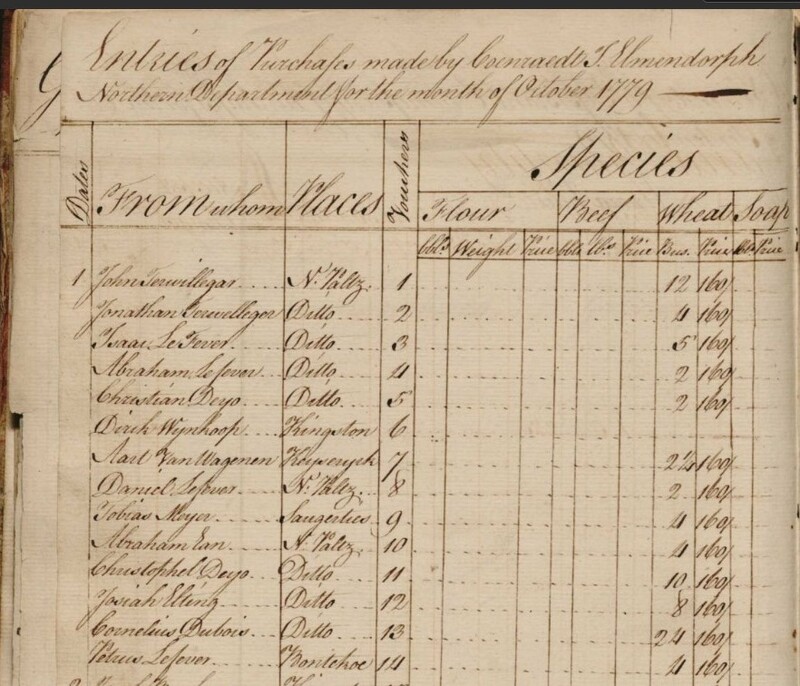
“Entries of Purchases made by Coenraedt J. Elmendorph 2 Asst. Commissary of Purchases for the District of the Counties of Ulster and Orange in the Northern Department,” 1778–1779. Andrew Elliot Papers, New York State Library Manuscripts and Special Collections.
Notes
[1] Testimony, Roelof Josiah Eltinge, October 26, 1776, cited earlier, https://nyheritage.contentdm.oclc.org/digital/collection/p16694coll153/id/20122/rec/54.
[2] Heidgerd, The American Descendants of Chrétien Du Bois of Wicres, France, Part Two, 6.
[3] For more on the Owl Church and to explore the original documents, see the section “The Coetus-Conferentie Dispute in New Paltz” in the finding aid by Beth Patkus, “Reformed Church of New Paltz Records (1683-1911)” (2026), https://www.huguenotstreet.org/reformed-church-of-new-paltz-records.
[4] Shefsiek, “A Suspected Loyalist,” 46.
[5] “Entries of Purchases made by Coenraedt J. Elmendorph. Asst. Commissary of Purchases for the District of the Counties of Ulster and Orange, 1778–1779.” Andrew Elliot Papers, New York State Library Manuscripts and Special Collections.