Imprisonment
On October 26, 1776, the day of his verdict, Roelof Josiah (hereafter simply Roelof) took the time to make a list, about twelve pages long, of debts that were owed to him.[1] The list included Jacob Hasbrouck Jr. (who owed Roelof 4 pounds, 4 shillings, and 3 ½ pence), and other neighbors like Daniel DuBois, Wyntje Hasbrouck, and Andries LeFevre Jr. Among the largest debtors were Benjamin DuBois, Gerrit Freer Junior, and Roelof’s father-in-law Johannes M. Louw, who owed 54 pounds, 9 shillings. “George Wertch” (probably George Wirtz, the town’s doctor and husband of Esther Hasbrouck Wirtz) owed Roelof 6 pounds, 6 shillings, and 9 ½ pence. After the list of debtors was compiled, the account book appears to have been put aside, with no further entries made until almost ten years later, for Roelof was soon sent away.
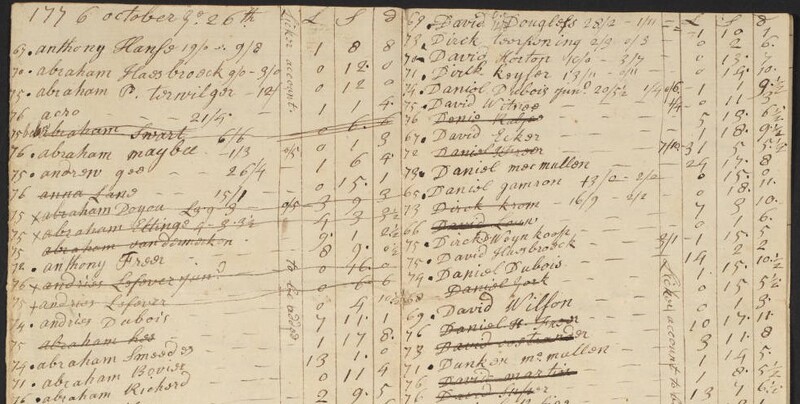
Account Listing, October 26, 1776 (detail). Roelof J. & Ezekiel Elting Family Papers, HHS Archives.
Click image to view the full document.
The events that followed are recorded in a remarkable diary that Roelof began keeping at this point. The earliest entry refers to his meeting with the Committee of Safety but mentions no outcome. However, just after that, Roelof noted that on December 8 he left Fishkill, New York (on the east side of the Hudson River), where he was first imprisoned. A few days later he reported that he was confined to the home of a Lieutenant Belknap in Atkinson, New Hampshire, and then moved to the home of Lieutenant Colonel Joseph Welch. His brother Solomon was already in New Hampshire, having arrived a month earlier. It appears that both brothers were then imprisoned at Exeter.[2]
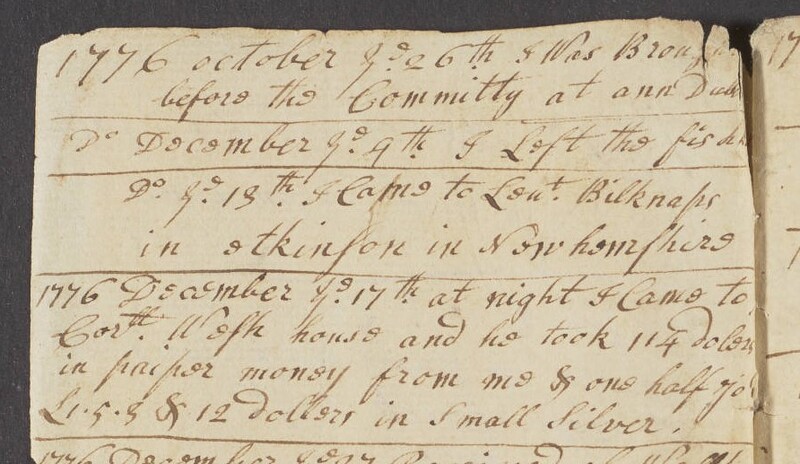
Diary and account book, Roelof J. Elting, 1777-1781 (detail, page 1). Roelof J. & Ezekiel Elting Family Papers, HHS Archives.
Click image to view the full volume.
Soon afterwards, Roelof recorded information about his watch in his diary, “number of my Watch 786 makers name Raynor – London.” This suggests that Roelof might have feared the watch would be stolen or that it was taken from him. The list of debtors, the diary, and the note about the watch all point to Roelof’s state of mind as his future must have felt precarious.
As if things weren’t challenging enough, Roelof and his wife Maria’s youngest daughter, Jannetje, died in January 1777,[3] about a month after Roelof was sent to New Hampshire. Jannetje was only six years old. While the diary records Roelof’s movements and places of confinement, there’s no mention of this tragedy or another that would befall the family a year later.
Two letters survive from the brothers’ time in New Hampshire, one from December 24, 1776 and one from February 22, 1777. Solomon wrote home to his family and friends in New Paltz, addressing them in Dutch, “Dear Father and Mother, Brothers, and Sisters, and all my friends …” Neither letter has been fully translated to English, but their content appears to be the usual exchange of well wishes, updates on their health, and Solomon’s pious meditations (to be discussed later). Both Roelof and Solomon exchanged letters in English with their father and other family members, but these and other letters written in Dutch by Solomon suggest that Dutch was used familiarly in the community.[4]
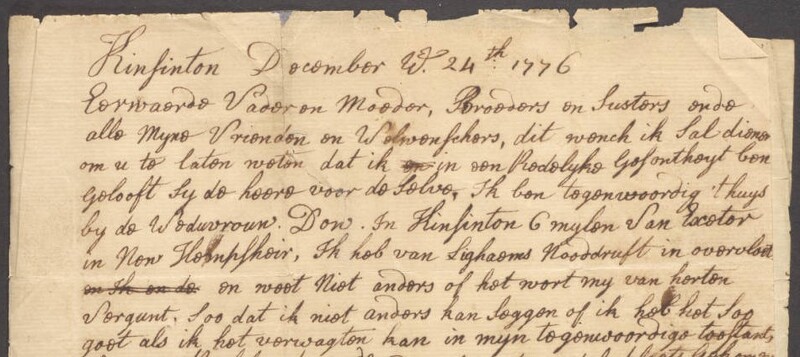
Letter (in Dutch), Solomon Eltinge to Josiah Eltinge, December 24, 1776 (detail). Josiah Elting Papers, Haviland-Heidgerd Historical Collection, Elting Memorial Library.
Click image to view the full document.
Notes
[1] Account Listing, October 26, 1776. Elting Papers, HHS Archives, https://nyheritage.contentdm.oclc.org/digital/collection/p16694coll153/id/29257/rec/67.
[2] Roelof Josiah Elting’s Diary and Account Book (page 4), https://nyheritage.contentdm.oclc.org/digital/collection/p16694coll153/id/6390/rec/1. Regarding Solomon's arrival in Exeter, see Shefsiek, "A Suspected Loyalist," 41.
[3] James W. Elting, The Descendants of Jan Eltinge, the Genealogy of the Elting/Eltinge Family (Published by the author, August 2002), 36.
[4] Letters (in Dutch), Solomon Eltinge to Josiah Eltinge, December 24, 1776 and February 22, 1777. Josiah Elting Family Papers, HHHC, https://nyheritage.contentdm.oclc.org/digital/collection/p16694coll153/id/16239/rec/56 and https://nyheritage.contentdm.oclc.org/digital/collection/p16694coll153/id/16552/rec/59. There are later letters from Solomon to his father, sometimes in Dutch and sometimes in English. Thank you to Dr. Jaap Jacobs for reading through and providing his insight into the general content of the Dutch letters (email correspondence dated April 27, 2026, from Jaap Jacobs to Josephine Bloodgood). Kenneth Shefsiek discusses the Dutch letters in his book Set in Stone: Creating and Commemorating a Hudson Valley Culture (State University of New York Press, 2017), 134 and 161.