Articles of Association
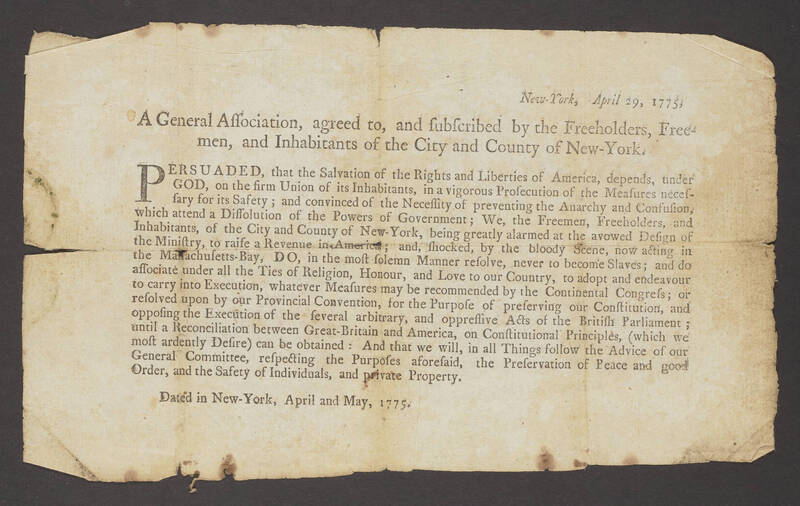
Articles of Association, 1775. Roelof J. & Ezekiel Elting Family Papers, HHS Archives.
Click image for more information.
Roelof Josiah and Solomon Eltinge’s Revolutionary War story began in 1775 with the signing of a document referred to as “the General Association” (commonly known as the Articles of Association), an important step in the growing conflict between the colonies and Great Britain. The discord had started a decade earlier when, saddled with debt from the Seven Years’ War (1754–63), the British government began imposing direct taxes on North American colonies, including the Stamp Act of 1765. Those resisting the new policy contested London’s claim that it had the power to tax the colonial inhabitants of the British Empire directly, arguing that it was a fundamental threat to their liberties as British subjects. A divide developed among colonists: Those dedicated to American resistance became known as Rebels or Patriots, those sympathetic to the British were called Loyalists or Tories.
The crisis deepened when, after the Boston Tea Party on December 14, 1773, Britain’s Parliament passed a series of laws that Patriots labeled “the Intolerable Acts.” In New York, where many inhabitants opposed the Rebel position, resistance to imperial policy was less powerful. Even so, local groups calling themselves “the Sons of Liberty” (including one in New Paltz) coordinated with their counterparts in other towns to form “Committees of Safety.” After the Battles of Lexington and Concord on April 19, 1775, these Committees selected delegates to a New York Provincial Congress held in New York City, which assumed control of the colony’s government.
The New York Provincial Congress prepared the Articles of Association in April and May 1775, transmitted it to every county in New York, and ordered it to be signed by every head of household. Those who obeyed this order agreed to “adopt and endeavor to carry into execution whatever measures may be recommended by the Continental Congress [a convention of delegates called together from the thirteen colonies, which met in Philadelphia] or resolved upon this Provincial Congress for the purpose of preserving our Constitution, and opposing the execution of the several arbitrary and oppressive acts of the British Parliament.” The Provincial Congress reported individuals who did not sign the Articles of Association before July of 1775 to the Continental Congress and marked them as enemies of the American cause. In New Paltz, Roelof Josiah Eltinge and Solomon Eltinge both signed the articles.[1]
Notes
[1] LeFevre, History of New Paltz, 168–169.