Oath of Allegiance
In March 1777, Roelof was sent back to New York from New Hampshire and, in early May, made an appearance before the Commissioners in Poughkeepsie. A week or so later he was given an order to report to the “fleet prison” (a privateer vessel adapted to house prisoners) at Kingston six days later. Roelof remained on board the fleet prison for a month, at which point he was paroled to the home of his brother-in-law Jacobus Hardenbergh in Hurley. Roelof remained there until the fall, when he and Cadwallader Colden Jr. (a sometime luncheon companion on parole at the Van Deusen House in nearby Hurley) were taken into custody by the militia.[1]
The Coldens were known supporters of royal authority. Cadwallader Colden Sr. had been a colonial government official, serving as lieutenant and acting governor under the king at various times. While Roelof’s support of the king and British authority was not so clear, the connection to Cadwallader Jr. at this volatile time was certainly compromising. As British forces were deemed too close for comfort, the Council of Safety threatened removal of suspected Loyalists to Hartford, Connecticut. However, both Roelof and Cadwallader were released and returned to Hurley.[2]
Soon after, however, Roelof was taken and imprisoned again at Kingston. The timing was not good. On October 16, 1777, Roelof recorded this account of the British forces’ burning of Kingston in his diary:
[A guard] Came to the Dors and told
us in Goal [jail] that he had orders to
Cary us off and the Doors Where
opened and We Ware hurried of
as soon as We had got out of
the town it Was in flames —
We marched on to marlbeltown [sic] …
Having escaped the fires, Roelof remained at Marbletown as a prisoner in the home of Johannes Tack for several weeks. Eventually in December, he and Cadwallader were sent to an area of Dutchess County near the Connecticut border known as the Nine Partners. They were shifted around to various homes and then given a two-week parole to return home to family.
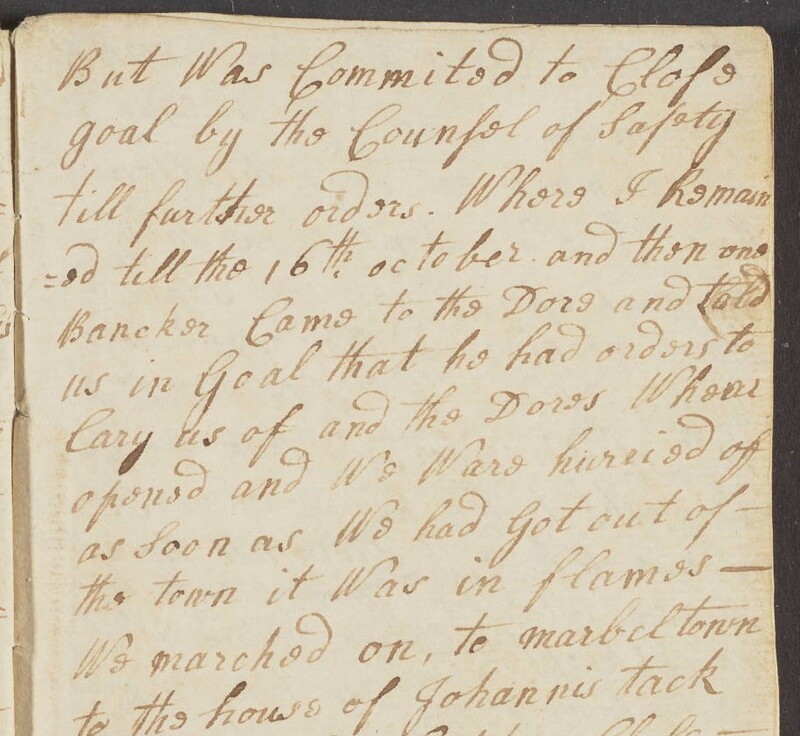
Diary and account book, Roelof J. Elting, 1776-1784 (detail, page 7). Roelof J. & Ezekiel Elting Family Papers, HHS Archives.
Click image to see the full volume.
The two-week parole turned into a few months, interspersed with multiple appearances before the commission in Poughkeepsie. In February, a second tragedy struck the family. Roelof and Maria’s eldest daughter, Rebecca, died at age seventeen.[3] The exact date is unknown, but it may explain in part why on February 19, Roelof was granted a permit at Poughkeepsie to return home for one month. He remained mostly at home until July, when both he and Cadwallader Colden Jr. were given one last chance to regain their freedom. They were offered the opportunity to take an oath of allegiance to the laws of New York; if they refused, they would be banished to British-controlled New York City. Cadwallader declined the oath on July 4. Two days later on July 6, Roelof did the same. On August 1, Solomon followed suit and also refused to sign the oath.[4]
Notes
[1] Roelof Josiah Elting’s Diary and Account Book (page 5), https://nyheritage.contentdm.oclc.org/digital/collection/p16694coll153/id/6370/rec/76.
[2]] For more on the Coldens, see Eugene Fingerhut, Survivor: Cadwallader Colden II in Revolutionary America
(University Press of America, 1983), cited in Shefsiek, “A Suspected Loyalist.”
[3] Elting, The Descendants of Jan Eltinge, 36.
[4] Roelof Josiah Eltinge’s Diary and Account Book (page 9), https://nyheritage.contentdm.oclc.org/digital/collection/p16694coll153/id/6374/rec/76. See also Shefsiek, “A Suspected Loyalist,” 40–41.