Background
Roelof Josiah Eltinge (born 1737) and Solomon Eltinge (born 1742) were the second and third sons of Josiah Eltinge and his wife Magdalena DuBois of New Paltz. They bore the surname of their great-grandfather Jan Eltinge, who was born in the province of Drenthe in the Netherlands and arrived in the Hudson Valley in the 1660s. In 1672, at the early Dutch settlement of Nieuw Dorp (today’s Hurley, New York), Jan married Jacomyntje Slecht (widow of Jan Kunst and Gerrit Foecken). Jacomyntje and Jan both witnessed the land agreement made in 1677 between twelve French Protestant men and local Esopus sachems for the nearly 40,000 acres that comprised the New Paltz Patent.
The Eltinges’ connection to New Paltz deepened when in 1703 Jan and Jacomyntje’s son Roelof (for whom Roelof Josiah was named) married Sarah DuBois, a granddaughter of Louis DuBois and daughter of Abraham DuBois, both New Paltz patentees. In July 1710, the elder Roelof was listed as constable for New Paltz and in 1712 he served as a witness for the will of patentee Jean Hasbrouck, indicating the extent to which the Eltinges were by then integrated into the community. Around 1726 Roelof purchased land on the Plains south of the village of New Paltz from his wife Sarah’s uncles, Solomon and Louis DuBois Jr. The couple are said to have resided and raised their family on that property.[1]
After Abraham DuBois’s death, Roelof eventually acquired his father-in-law’s village lot and several other parcels in New Paltz in 1734. Almost fifty years earlier, Abraham DuBois had built a stone house on the village lot (today’s 88 Huguenot Street) that was located between the homesteads of patentees Abraham Hasbrouck and Louis Bevier. [2] Roelof is believed to have purchased the village lot and stone house (demolished in 1798) for his son Josiah, who married Magdalena DuBois that year. Magdalena was both the first cousin of Josiah’s mother and the half-sister of his father. In this way, the Eltinges and the DuBoises were inextricably linked.
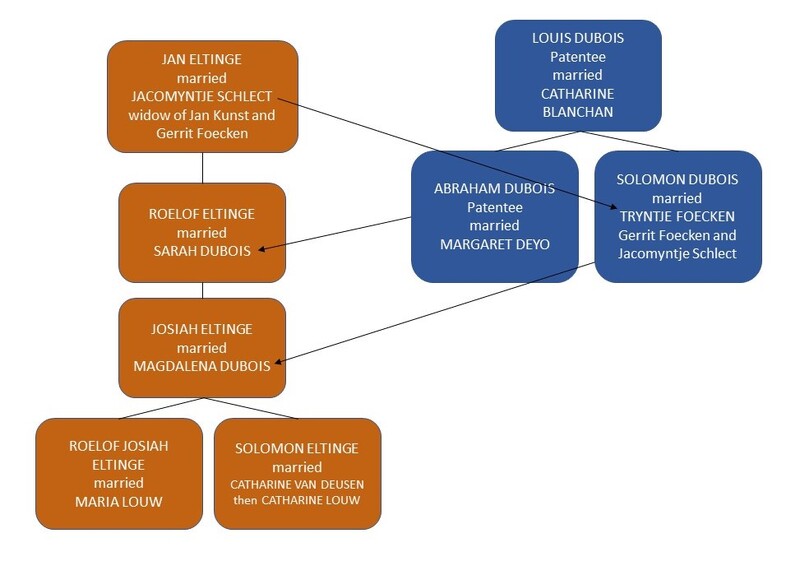
Chart showing the lineage of brothers Roelof Josiah Eltinge and Solomon Eltinge.
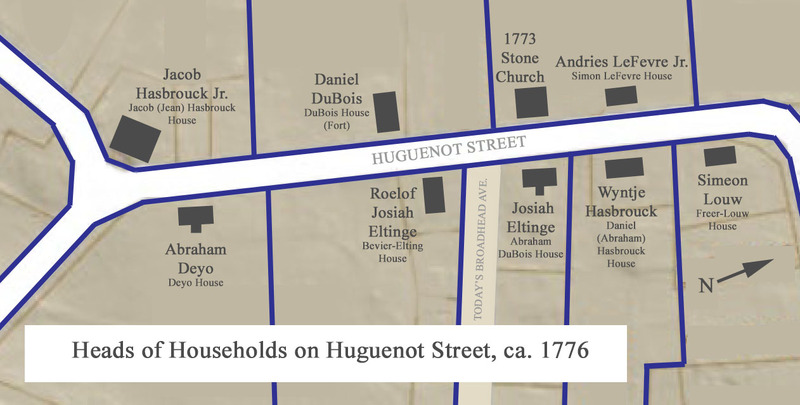
Map showing house locations and listing heads of households along Huguenot Street, ca. 1776.
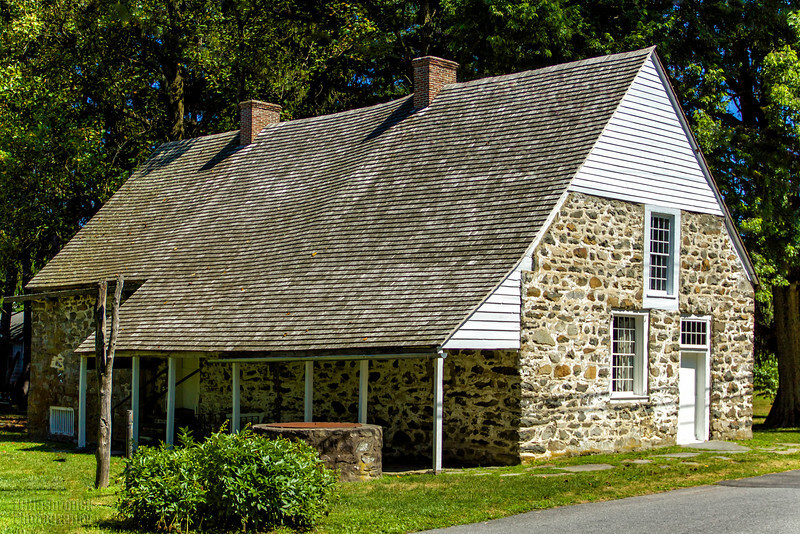
Today's Bevier-Elting House at 84 Huguenot Street, where Roelof Josiah Eltinge and family lived.
Josiah reinforced the Eltinge family’s prominent place in New Paltz through the purchase of the Bevier family’s stone house (today known as the Bevier-Elting House at 84 Huguenot Street) in 1760. As his father had done for him, Josiah probably purchased the house for his son Roelof Josiah, who married Maria Louw the same year. Maria was the great-granddaughter of patentee Hugo Freer. In 1763 Josiah signed an agreement with his son to lease the property to him for one penny per year for ten years.[3] Roelof Josiah and his family (the couple eventually had eleven children) were already residing in the house, and he was running a store out of the front room. The store also seems to have served as a meeting place and tavern.

Two men pointing at a boy, 1711. Engraving by Jan Luyken. Rijksmuseum.
Enslavers
Like other well-to-do Ulster County families of the period, the Eltinges enslaved several people of African descent whose labor contributed significantly to their wealth. Josiah Eltinge is known to have enslaved at least three men and one woman in 1755. A woman named Saur was listed in his will along with two children, Jin and Jack. According to various documents, Roelof Josiah enslaved people named Sessor, Sam, Tam, Bett, Lon, John, Bram, Kloyntam, Isabel, Deyn, Robert, and possibly a second woman named Bett. According to the 1800 US Census, Roelof Josiah’s brother Solomon enslaved two people that year. In 1807 Solomon purchased a woman named Mary. A woman named Lena was mentioned in his 1809 will.[4]
Notes
[1] Deed cited in Ralph LeFevre, History of New Paltz, New York, and Its Old Families, (From 1678 to 1820) (Fort Orange Press, 1909), 483.
[2] Deed, Abraham DuBois to Roelof Eltinge, June 27, 1734. Roelof J. and Ezekiel Elting Family Papers, Historic Huguenot Street Archives (hereafter “Elting Papers, HHS Archives”), https://nyheritage.contentdm.oclc.org/digital/collection/p16694coll153/id/7454/rec/6. The house lot is mentioned about one-third down the first page. Regarding the stone house that was built there, see Kenneth Shefsiek, “Another House on Huguenot Street: The Discovery of the DuBois-Elting House,” (unpublished, February 2002), a copy of which is in the HHS Library.
[3] Deed, Abraham Bevier, Abraham LeFevre, et al. to Josiah Eltinge, May 12, 1760. Eltinge Papers, HHS Archives, https://nyheritage.contentdm.oclc.org/digital/collection/p16694coll153/id/7344/rec/29.
Lease, Josiah Eltinge to Roelof Josiah Eltinge, December 22, 1763. Elting Papers, HHS Archives, https://nyheritage.contentdm.oclc.org/digital/collection/p16694coll153/id/7262/rec/28
[4] For people enslaved by Josiah Eltinge (some whose names were once known):
E. B. O’Callaghan, “Census of Slaves, 1755,” in Documentary History of the State of New-York, vol. 3: 849.
Last Will and Testament, Josiah Eltinge, dated April 4, 1767 and probated May 19, 1784. Elting Papers, HHS Archives, https://nyheritage.contentdm.oclc.org/digital/collection/p16694coll153/id/6799/rec/1.
For known people enslaved by Roelof Josiah Eltinge:
Sessor, Sam, Tam, and Bett are named in the Estate Inventory of Roelof Josiah Eltinge, undated. Elting Papers, HHS Archives, https://nyheritage.contentdm.oclc.org/digital/collection/p16694coll153/id/6684/rec/3.
Tam, Lon, John, Bram, Kloyntam, Isabel, and Deyn are named in List of Legal Documents, 1716-1784. Elting Papers, HHS Archives, https://nyheritage.contentdm.oclc.org/digital/collection/p16694coll153/id/6833/rec/5.
Robert is named in the Register of Slaves, 1799–1825. New Paltz Town Records, courtesy of HHS, https://nyheritage.contentdm.oclc.org/digital/collection/p16694coll153/id/27234/rec/1.
A woman named Bett is mentioned in Maria Louw Eltinge’s Release of Dower, September 10, 1795. Elting Papers, HHS Archives, https://nyheritage.contentdm.oclc.org/digital/collection/p16694coll153/id/6858/rec/2.
For known people enslaved by Solomon Eltinge:
1800 US Federal Census for Hurley, New York. Bill of Sale for Mary, April 24, 1807. Josiah Eltinge Family Papers, Haviland-Heidgerd Historical Collection, Elting Memorial Library (hereafter HHHC), https://nyheritage.contentdm.oclc.org/digital/collection/p16694coll153/id/16235/rec/33. Solomon Eltinge’s 1809 will is summarized in William and Ruth P. Heidgerd, The Elting Family (1989), 15.