A Wife's Experience
After his imprisonment in New Hampshire, Roelof had been allowed to return home for various periods until his exile to New York City and Long Island, from where he seems not to have been permitted to go home. Roelof and Maria had been married in 1760 at the Old Dutch Church in Kingston. Maria’s parents, Johannes M. Louw and Rebecca Freer, had inherited the original Freer homestead property a few doors north of the Eltinges. They lived in a wood-frame house possibly built for the patentee Hugo Freer, Rebecca’s grandfather, only later (in 1762 and 1763) building the stone house that exists today. [1] Thus, Roelof and Maria would have grown up together as near neighbors.
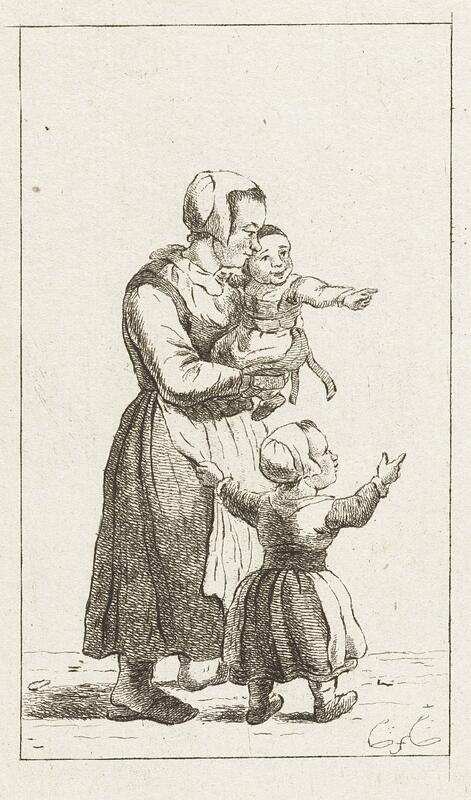
Mother with two children, 1777-1779, by Pieter de Mare. Etching. Rijksmuseum.
By the time of Roelof’s incarceration, Maria had given birth, within a period of fifteen years, to eleven children. Their eldest, Rebecca, was born in 1760 and their youngest, Maria, was born in 1775. As mentioned earlier, a month after Roelof’s removal to New Hampshire in January 1777, the couple’s six-year-old daughter Jannetje died. Maria would have suffered through that loss without her husband by her side. No information about how Roelof was informed of the death has been found, but a letter home from Solomon the following month indicates Roelof was thinking of his loved ones, relaying through Solomon’s writing the “teeders liefde” (tender love) he felt for Maria and the family.[2] When the couple’s eldest daughter Rebecca died two years later, Roelof may have been home on parole, but the threat of his removal during that time was ongoing. The family’s grief, on top of all the stress, must have been shattering.
When Roelof was exiled to New York City in August 1778, Maria and the surviving children might have joined him, as mentioned earlier, but they chose to stay in New Paltz in the family’s home, perhaps finding comfort living among their extended family and faithful friends. Roelof’s parents, Josiah and Magdalena, lived next door and Josiah likely helped guide the family’s business affairs. Maria’s own parents had died by this time, but her brother Simeon and family lived nearby. Maria and Roelof’s eldest surviving children were teenagers at this point and would have contributed to household operations in a variety of ways, taking on more responsibility as they matured. Additionally, labor and support may have come from people of African descent that the family likely enslaved at this time. Records show that Roelof and Maria enslaved a number of people after the war to make their lives easier (see Background), but it is unclear if they enslaved people before and during the war. It seems likely as Roelof’s father Josiah enslaved several people by this time, as did most of their neighbors.
Maria and children may have maintained a relatively routine life, although made much harder by Roelof’s absence, and by the war, inflation, and the possible animosity they may have endured from fervent Patriots in the community as the family of two perceived Loyalists. Still, they were fortunate in that they retained their home and extensive lands at a time when local governments seized most properties of imprisoned Loyalists. As a result, they were better off than many in the same predicament.
In July 1780, Maria and children were granted permission to visit Roelof behind British lines by James Pattison, Major-General of His Majesty’s Forces, Commandant of New-York.[3] It is unknown if they traveled at that time, but the family did visit Roelof in April 1781, when he recorded in his diary, simply, “With my family 11 Days.” According to records, Maria traveled with Cadwallader Colden Jr.’s wife on that trip. Maria apparently carried with her 216 pounds, 16 shillings, and 11 pence in “three sorts of money” from her father-in-law Josiah that was to be shared in equal parts by Roelof and Solomon. Roelof and Maria’s eldest son Ezekiel, age eighteen, apparently set out with the family, but was directed home by the American General William Heath when they were stopped at West Point. A note was made that the general found “a quantity of provisions … over and above what appeared necessary to support the families on their way to the enemy.” The goods were seized and put in public stores.[4]
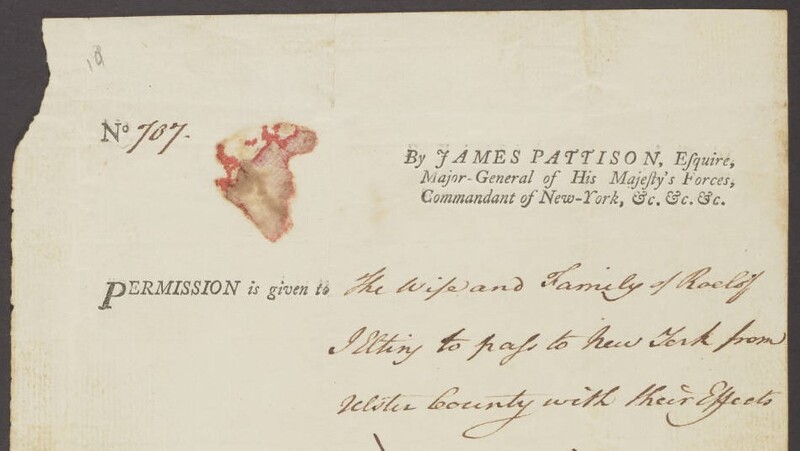
Pass for Maria and family, July 29, 1780 (detail). Roelof J. & Ezekiel Elting Family Papers, HHS Archives.
Click image to view the full document.
There is only one surviving letter between the couple to give us a window into what Roelof and Maria’s relationship might have been like. Written at the close of the war, the letter from Roelof to Maria begins, “Loveing Wife I take this opportunity to acquaint you that I and Brother Salomon are, By the Blessing of God in Good health and am in hopes to hear the Same from you and Family.” Roelof then opines that he was at a loss as to advise her about going to see him, as they awaited news of a what he considered a definitive treaty between the British and the American Patriots. “And if it not Done soon,” Roelof wrote, “I am a Fraid it Will Be Some time Before I will Be able to Come home therefore I must Leave it to You to take your opportunity to Come.” The letter closes, “Remember my Love to you and Family and all Friends. Your Loveing Husband.”[5]
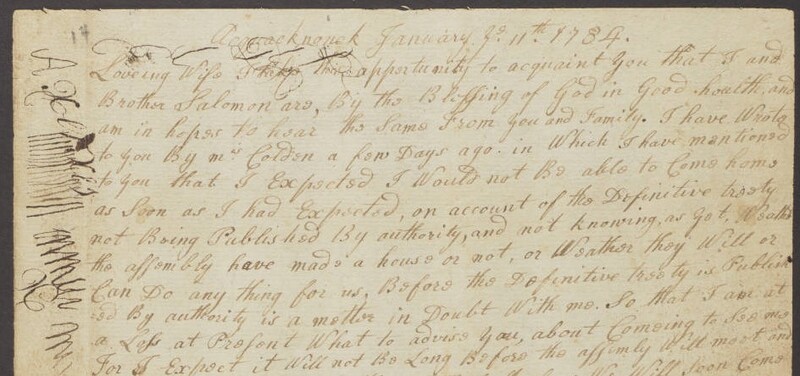
Letter from Roelof Josiah Eltinge to his wife Maria, January 11, 1784 (detail). Roelof J. & Ezekiel Elting Family Papers, HHS Archives.
Click image to view the full document.
Notes
[1] Elting, The Descendants of Jan Elting, 36. Regarding the Freer homestead, see Larson Fisher Associates and Crawford & Stearns Architects, Historic Structure Report for the Freer-Louw House, New Paltz, Ulster County, New York (2010).
[2] Letter (in Dutch), Solomon Eltinge to Josiah Eltinge, February 22, 1777, cited earlier, https://nyheritage.contentdm.oclc.org/digital/collection/p16694coll153/id/16552/rec/59.
[3] Pass for Maria and family, July 29, 1780 (detail). Roelof J. & Ezekiel Elting Family Papers, HHS Archives,
https://nyheritage.contentdm.oclc.org/digital/collection/p16694coll153/id/9274/rec/73.
[4] Regarding Josiah sending the money with Maria see Letter in English, Josiah Eltinge to Solomon Eltinge, April 4, 1781. Josiah Elting Family Papers, HHHC, https://nyheritage.contentdm.oclc.org/digital/collection/p16694coll153/id/16212/rec/8.
Regarding Ezekiel, see New York State, Public Papers of George Clinton (New York and Albany: State of New York, 1899-1914) VI, 756, cited in Shefsiek, “A Suspected Loyalist,” 50, n50.
[5] Letter in English, Roelof Josiah Eltinge to his wife Maria Louw Eltinge, January 11, 1784. Elting Papers, HHS Archives, https://nyheritage.contentdm.oclc.org/digital/collection/p16694coll153/id/4469/rec/96.