
Literacy
John is known to have kept two account books over the years, revealing that he had learned to read and write and to do arithmetic by 1830. There was in fact a New York State law passed in 1810 requiring Black children born under gradual abolition be taught to read and write or they were to be released at age twenty-one, so John’s education is not entirely surprising. In Manhattan and nearby counties, some Black children deprived of an education brought their stories to the New York Manumission Society and successfully won release in court.[1] Brothers Josiah and Jacob J. Hasbrouck would likely have complied with the 1810 law and provided John a basic education, just as they, while each serving in the position of Town Clerk, had dutifully recorded births of children reported to them in the Register of Slaves, complying with the 1799 “Act for Gradual Abolition.” Still, it would seem not all enslavers responsible for children born under gradual abolition followed the 1810 law, as we shall see.

Detail of a page in John Hasbrouck Account Book 2. Haviland-Heidgerd Historical Collection, Elting Memorial Library.
When provided, education may have been informal. In John’s case, various members of either Hasbrouck household, even older children or their private tutors, might have taught John to read, write, and do basic math. Some have suggested that schools in New Paltz were integrated at an early date. Longtime Ulster County Historian Kenneth Hasbrouck implied that the Jenkinstown school (located near Josiah Hasbrouck’s home at Locust Lawn) was attended by both Black and White students and wrote that the nearby Kettleborough school “was always racially integrated.”[2] The latter appears to have been the case in 1833, when at least five children of “colored” men were noted in the Kettleborough school records.[3] Ralph LeFevre’s citation of Black builder Jacob Wynkoop in The History of New Paltz suggests the village school was also integrated at that time: “Our first definite knowledge concerning the school and its teachers is derived from Jacob Wynkoop, mainly, and dates back to 1833.”[4] Jacob Wynkoop did attain literacy, but both his account of the village school and the Kettleborough records are some years later than when John Hasbrouck would have first been learning to read and write.
Most Black children in New Paltz during John’s youth and even later probably did not receive formal schooling. According to the 1850 census for Poughkeepsie (the first federal census to record this information), John’s sister Jane Hasbrouck Deyo may not have had the opportunity to learn to read and write, suggesting their de facto enslaver may have provided greater educational opportunities to John based on his gender. In the 1850 census for New Paltz, Jane Deyo Wynkoop, Simon Deyo, Robert Elting, and Samuel Franklin,[5] all having grown up under gradual abolition and being of similar age to John and his sister, had the box checked for “cannot read or write.” Again, in their cases, the men that indentured them as children apparently failed to provide the education required by law. Indeed, a survey of all twenty-five Black heads of households named in that census indicated that nearly all of these people, ranging in age from twenty to eighty-seven, were recorded as unable to read or write. Besides John, the exceptions appear to have been Catharine DuBois (understood to have been indentured by the father of Josiah Hasbrouck’s son-in-law Josiah DuBois, also likely to comply with the 1810 law), Anthony Timbrook (indentured by Josiah R. Eltinge, Ezekiel’s brother, also likely to comply), and James Thomas (James had escaped slavery from Maryland, arriving in New Paltz in the 1840s).[6]
John’s pride and dedication to writing is exemplified throughout his two account books and personal papers. John’s spelling and grammar were imperfect and comparable to that of others in New Paltz in the first half of the 19th century.[7] Although his wife Sarah was reported as never having learned to read or write, John likely wanted his children to have the same advantage he had. In 1847, he accepted a spelling book and a primer as payment for work he had done from John W. DuBois.[8] In 1850, John acquired a copy of Sanders’ Union Fourth Reader from Simon Rose. The books were likely used first by his eldest children Margaret and Philip and then passed on to his younger daughters. According to the 1850 census, Margaret, age thirteen, and Philip, age eleven, both attended school, presumably in the Ohioville district. John paid for his children’s education through labor for Simon Rose that year.[9]
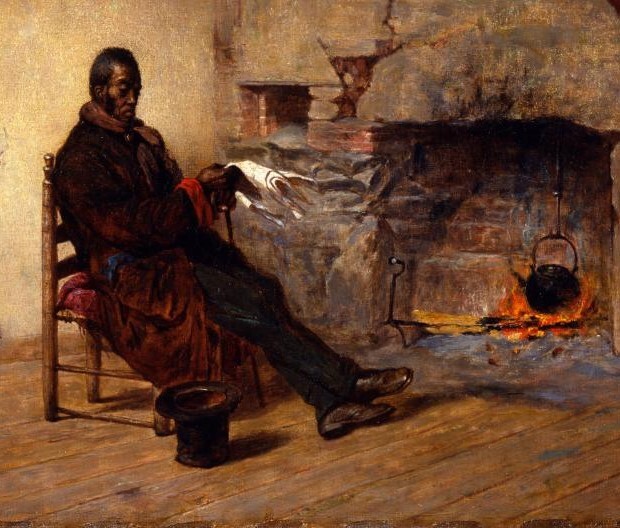
Detail from Edwin White's Thoughts of the Future, 1861. The New York Historical.
Notes
[1] Sarah L. H. Gronningsater, The Rising Generation: General Abolition, Black Legal Culture, and the Making of National Freedom (University of Pennsylvania Press, 2024), 82–3.
[2] William Heidgerd, Black History of New Paltz (Part 1), (Haviland-Heidgerd Historical Collection, Elting Memorial Library, 1986), 15-16.
[3] Kettleborough School District Minutes and Records, 1827–1927. New Paltz Town Records, courtesy of HHS. https://nyheritage.contentdm.oclc.org/digital/collection/hhs/id/1895/rec/25, image 9.
[4] LeFevre, appendix, 161.
[5] Simon Deyo was born on December 9, 1812 to a woman enslaved by Jonathan Deyo, while Robert Elting was born on November 10, 1812 to a woman enslaved by Roelof Elting. Register of Slaves cited earlier, image 31 and 30, respectively. Regarding Samuel Franklin, see Joan DeVries Kelley, “Some Ancestors of Nelly Jane (Franklin) LeFevre: An African American of the Mid-Hudson Valley” NYG&B Record, vol 145 (2014) no. 4: 245–58. Interestingly, Samuel Franklin’s name (with no color designation) is among the parents named in the Kettleborough School District Minutes and Records cited earlier, while two other men are listed as “colored”: Shawn Hasbrouck and Charles DuBois on the same page.
[6] The birth of a girl named Catharine to a woman enslaved by Cornelius DuBois Junr. and the birth of Anthony and his sister Susan to a woman enslaved by Josiah R. Eltinge (Ezekiel’s brother) appear in the Register of Slaves, images 18, 32, and 36. Susan and Anthony’s family took the surname Ten Brouck (sometimes Tenbrook or Timbrook) after emancipation. Thanks to Zachary Veith for making this connection. Note that James Thomas is listed in the 1855 New York State Census as unable to read and write, but the 1865 New York State Census did not have that box checked. See “A Short Sketch of the Life of James Thomas, A Runaway Slave,” New Paltz Independent, March 16, 1888 and transcribed on FindaGrave.com.
[7] See Letter to Mr. Thomas N. Jenson, Esq. from Riley Rand, 1844. Cornelius T. Jansen Family Papers, HHS Archives. https://nyheritage.contentdm.oclc.org/digital/collection/p16694coll153/id/4187/rec/7
[8] Hasbrouck Account Book 2, image 45.
[9] Hasbrouck Account Book 2, images 69 and 77.