
Childhood Under Gradual Abolition
In early 1806, Peg, a woman enslaved by Jacob Hasbrouck Jr., gave birth to a son. The town’s Register of Slaves, kept as required by law, recorded: “February the Eleventh Jacob Hasbrouck had a Negro Male Child born of his wench and called his Name John.” By this time, Jacob Jr. had built a stone house north of Huguenot Street in an area known as “The Bowery.” Peg and John would have resided on this property, probably in an attic or cellar space or possibly in a separate outbuilding. John’s father Philip would have lived on the property of his enslaver, Andries DuBois.[1]

Detail from the Register of Slaves, 1799-1825. New Paltz Town Records Collection, courtesy of HHS.
Click image to view full page.
Two years prior to John’s arrival, Peg had given birth on February 16, 1804 to a daughter named “Gin” (Jane), also Philip’s child. According to the 1799 abolition act, baby Jane would be bound in service to Jacob Hasbrouck Jr. until age twenty-five, but the conditions of her birth were even more complicated. The 1799 act also established an abandonment program, which enabled enslavers to legally abandon Black infants to the local Overseers of the Poor, then accept them back as boarders and require their service as they grew, all while collecting a monthly stipend from New York State. While in effect through May 27, 1804, the program resulted in the abandonment of an estimated 37.2 percent of children born to enslaved women, creating a financial burden for the state. The program was deemed unsustainable and terminated about six weeks after Jane’s birth. According to the Register of Slaves, Jacob Hasbrouck Jr. abandoned a three-month-old Jane on May 27, 1804.[2]

Detail from the Register of Slaves, 1799-1825. New Paltz Town Records Collection, courtesy of HHS.
Click image to view full page.

Detail from the Register of Slaves, 1799-1825. New Paltz Town Records Collection, courtesy of HHS.
Click image to view full page.
Jacob Hasbrouck Jr. died in June 1806. The infant John and his mother Peg appeared together in his estate inventory, where they were assigned a joint value of “125~0” ($125).[3] John’s sister Jane was listed as “Gin, aged two years” on the following line, revealing that Jacob Jr. had, after all, taken her back after abandoning her to the Overseers of the Poor. Jane was listed individually and valued at “0~6” (60 cents) apart from her mother, exposing that Jane, even as a toddler, was considered separate property to potentially be sold off or given to another White family member. The threat of separation was ever present for enslaved mothers and their children.
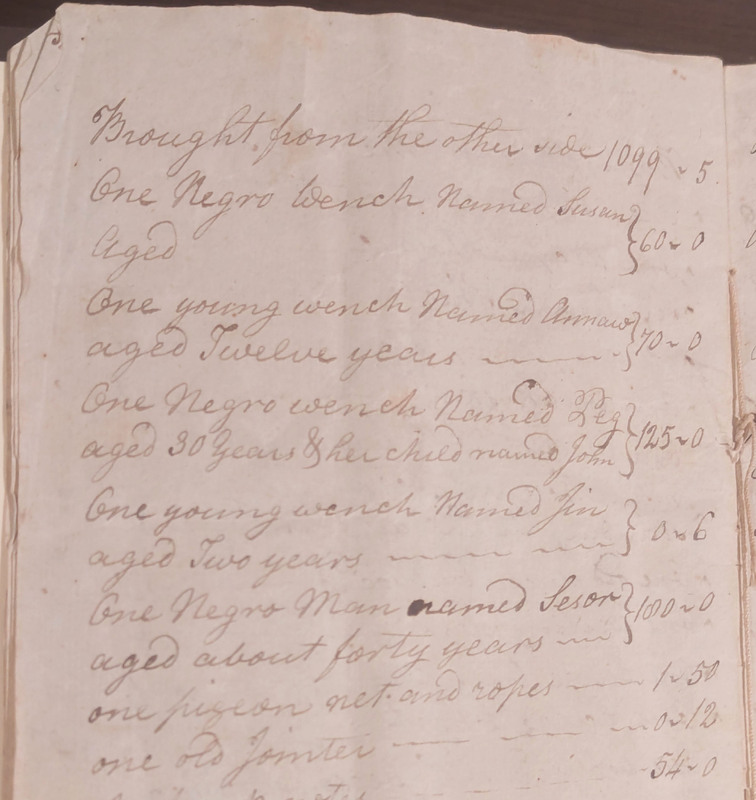
Detail from the Estate Inventory of Jacob Hasbrouck Jr., 1806. Levi Hasbrouck Family Papers, Locust Lawn Collection. Locust Grove.
Peg also had a daughter named Rachel for whom, unfortunately, no further information has yet been found. Rachel may have been born prior to the 1799 act and her birth never recorded (at least not in the Register of Slaves). If born before July 1, 1799, Rachel, like her mother, would have been enslaved for life.[4] Rachel’s name did not appear on Jacob Jr.’s estate inventory, but that of a twelve-year-old girl named Annaw was. A child, yet old enough to learn additional skills and perform significant amounts of labor, Annaw was valued at $70. An woman named Susan and a forty-year-old man named Sesor were valued at $60 and $100, respectively, on the inventory list as well.
Assuming Peg and at least her two younger children Jane and John remained together as a family throughout these early years, they were fortunate. As an older child, Rachel was likely sold or passed on to another member of the White Hasbrouck family, perhaps before Jacob Jr.’s death and the 1806 estate inventory. Many, if not most, enslaved families in New York were cruelly separated in this way. Sojourner Truth described in the Narrative that most of her siblings were sold away from her parents, which caused great heartache, especially for her mother. As a result, Sojourner would only get to meet a few of her siblings in her lifetime.[5]
John’s father Philip, as mentioned earlier, had a different enslaver, a man by the name of Andries DuBois. Andries owned land in the town of Shawangunk (southwest of New Paltz) and, after 1812, throughout New Paltz, including acreage on “the Flats” west of the Wallkill River, as well as one of the old village lots on what is now Huguenot Street. He also owned significant holdings just east of there in the area of today’s Millbrook Preserve (see Map of Locations).[6] Philip probably labored on each of Andries’s properties at various times.
While enslaved in New Paltz, Philip may have had the opportunity to see his children somewhat regularly, but residing together as a family unit would not have been possible. Marriages between enslaved people were not recognized legally in New York State until 1809 and even then, Philip, as an enslaved father, would have little, if any, practical and no legal control over the welfare of his children. Instead, that authority was in the hands of Peg’s enslavers, the White Hasbroucks.[7]

Jacob Hasbrouck Jr. House at the Bowery (photo by José Moreno-Lacalle)

Josiah Hasbrouck House, a.k.a. Locust Lawn (photo courtesy of Locust Lawn)

Jacob J. Hasbrouck House at Bonticou (photo by José Moreno-Lacalle)
After Jacob Hasbrouck Jr.’s death, ownership of Peg, Jane, and John is believed to have transferred to his younger son, Jacob J. Hasbrouck, who remained at the Bowery farm where appropriately aged enslaved people were reported in 1820. John’s obituary from years later points to Jacob J. as his and his mother’s enslaver.[8] However, a subsequent chronicler who knew John Hasbrouck’s son Philip noted “He [Philip] was the son of slave parents, born on the farm of Hon. Josiah Hasbrouck” (Jacob J.'s older brother) and later researchers have assumed this to be the case.[9] Peg and John likely resided with and labored for Jacob J. Hasbrouck primarily, but it is also possible they labored for each brother at different times.
Jacob J. and Josiah were both wealthy men with significant land holdings who held prominent positions both locally and beyond (both men served in the New York State Assembly and Josiah served two terms in the US Congress). A successful merchant, Josiah had inherited the family’s ancestral stone home on Huguenot Street and ran a store there, but by 1809 he had moved about three miles south of New Paltz and eventually built the Federal-style mansion known as Locust Lawn.[10] Meanwhile, Jacob J. inherited the Bowery farm, as mentioned, where he and his family would reside until 1823, when they moved a few miles north to Bonticou.[11]
After passage of the 1799 abolition act and during John Hasbrouck’s childhood, fugitive slave notices in regional newspapers doubled.[12] At least twice in John’s lifetime, Josiah Hasbrouck and his brother Jacob J. both advertised in pursuit of enslaved men seeking freedom. Josiah advertised for the capture of Hendrick in 1809, while Jacob J. advertised for Ben’s capture in 1816.[13] John and his mother Peg would have known Hendrick and Ben; they might also have been family. Peg and a young John likely revered these men for their bold resistance and courage, despite the risks they took for freedom.

Advertisement for Hendrick, 1809. Reproduced in In Defiance (footnote 13).

Advertisement for Ben, 1816. Reproduced in In Defiance (footnote 13).
During this same period, the Hasbroucks took more aggressive actions to recover what they considered their property. A document from 1810 shows Jacob J. and Josiah banding together with other enslavers to form “the Society of Negroes Unsettled.”[14] In this document, the enslavers pledged to support bounty hunters if any of their enslaved men listed were to self-emancipate. Jacob J. and Josiah themselves acted as bounty hunters in pursuit of men named Frank and Harry.[15] Jacob J. was granted power of attorney “to ask for, search, apprehend, and take” Frank. Jacob J. also signed a warrant for the apprehension of a man named Harry. While it is unclear if Frank was ever captured, Jacob J. and Josiah were successful in capturing Harry.[16] When caught, self-emancipating men and women would be severely punished, usually being whipped and/or made to wear chains or collars. Many freedom seekers who were caught were executed by hanging or sold, often to distant locations in the South and the Caribbean. This was the atmosphere of oppression and violence that would have permeated Peg and John’s lives while in bondage to the Hasbroucks.

Detail from Accounting for the "Society of Negroes Unsettled," 1811. Roelof J. & Ezekiel Elting Papers, HHS Archives. Click on image to see the full document.
Notes
[1] Register of Slaves, 1799–1825. New Paltz Town Records, courtesy of HHS. https://nyheritage.contentdm.oclc.org/digital/collection/p16694coll153/id/27205/rec/17, image 18. Peg’s name was revealed in the Estate inventory of Jacob Hasbrouck Jr., 1806. Levi Hasbrouck Family Papers: Locust Lawn Collection, Locust Grove Historic Site. The name of John’s father Philip appears in John Hasbrouck’s obituary in the New Paltz Times, August 7, 1879.
[2] Jane’s birth as Gin was reported by Jacob Hasbrouck in the Register of Slaves, image 15. John’s New Paltz Times obituary cited earlier includes the first names of two sisters, Jane and Rachel. Jane Hasbrouck Deyo, to be discussed later, named one of her sons Philip, presumably after her father. See the section, “Family.” The abandonment of “Gin” appears in image 43 of the Register of Slaves. For more on the abandonment program, see Chapter 3 in Vivienne L. Kruger, Born to Run: The Slave Family in Early New York, 1626 to 1827, PhD diss., (Columbia University, 1985). https://newyorkslavery.blogspot.com/2007/08/chapter-one.html
[3] Estate inventory of Jacob Hasbrouck Jr., 1806. Levi Hasbrouck Family Papers: Locust Lawn Collection, Locust Grove Historic Site.
[4] John Hasbrouck’s New Paltz Times obituary cited earlier. The 1798 Tax Assessment for New Paltz indicates that Jacob Hasbrouck Jr. had one enslaved female that was either under age twelve or over age thirty, for whom he would not be taxed.
[5] Gilbert, 15–16. For more on family separations, see Kruger cited earlier.
[6] 1800 US Federal Census for Shawangunk, NY. 1813 Lease for lands in Shawangunk by Andries DuBois to Edward Parliman, https://nyheritage.contentdm.oclc.org/digital/collection/p16694coll153/id/692/rec/41. Andries inherited the original stone LeFevre homestead on Huguenot Street from his uncle Andries LeFevre. That house was later demolished to make way for the Greek Revival brick Reformed Church built in 1839. See Ralph LeFevre, 319. Andries also owned significant acreage east of Huguenot Street that stretched from today’s Mulberry and Church Streets to North Putt Corners Road, which he deeded to his sons Nathanial and Jonathan around 1848. See Ulster County Land Records, Courtesy of the County Clerk: book 67, page 352; book 71, page 323; and book 70, page 83.
[7] See Chapter 3 in Kruger cited earlier.
[8] 1820 US Federal Census for New Paltz. Obituary for John Hasbrouck in the New Paltz Times, August 7, 1879.
[9] Peter Harp, “Horse and Buggy Days,” New Paltz News, November 1, 1972. Historians Joan Hollister and Sally Schultz attributed John’s familiarity with keeping account books to having been raised in the household of Josiah’s mercantile family. See Joan Hollister and Sally M. Schultz, “From Emancipation to Representation: John Hasbrouck and His Account Books,” Hudson River Valley Review, vol. 20, no. 2 (Spring 2004), 8.
[10] Locust Lawn is located at 436 State Route 32 South, Gardiner, NY. https://www.lgny.org/locust-lawn
[11] The brick house still stands at 250 White Duck Road, New Paltz. Anne Bienstock, “Jacob J. Hasbrouck House (c. 1830, c. 1850 and late 1990s renovations)” in Vals Osborne, ed., Legacies on the Land: Historic Houses, Hamlets, and Landscapes of Southern Ulster County (Black Dome Press, 2024), 76.
[12] Michael E. Groth, Slavery and Freedom in the Mid-Hudson Valley (SUNY Press, 2017), 60.
[13] Susan Stessin-Cohn and Ashley Hurlburt-Biagini, In Defiance: Runaways from Slavery in New York’s Hudson River Valley, 2nd ed. (Black Dome Press, 2023), 235 and 283. Josiah also advertised for a man named Peet in 1801 (page 168).
[14] Bounty Hunters’ Agreement, 1810. Roelof J. and Ezekiel Elting Family Papers, HHS Archives. https://nyheritage.contentdm.oclc.org/digital/collection/p16694coll153/id/9280/rec/3
[15] Accounting, “Society of Negroes Unsettled,” June 25, 1811. Roelof J. and Ezekiel Elting Family Papers, HHS Archives. https://nyheritage.contentdm.oclc.org/digital/collection/p16694coll153/id/6973/rec/6
[16] Power of Attorney, Jacob J. Hasbrouck, 1811. https://nyheritage.contentdm.oclc.org/digital/collection/p16694coll153/id/16006/rec/2 Warrant for Harry, 1811. Both Joseph and Jacob J. Hasbrouck Family Papers, HHS. https://nyheritage.contentdm.oclc.org/digital/collection/p16694coll153/id/15629/rec/6. Frank was enslaved by Roeliff Hasbrouck and Harry by William Hasbrouck. Both enslavers were distant cousin of John’s enslavers.