Academics
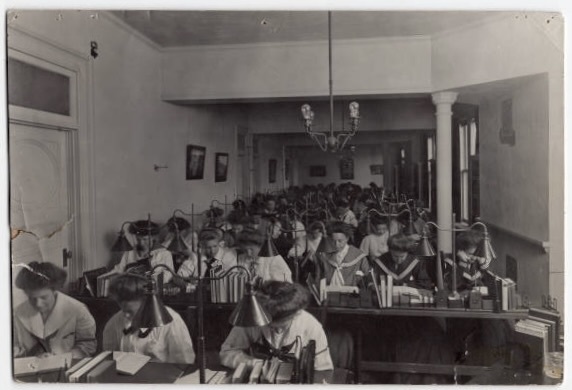
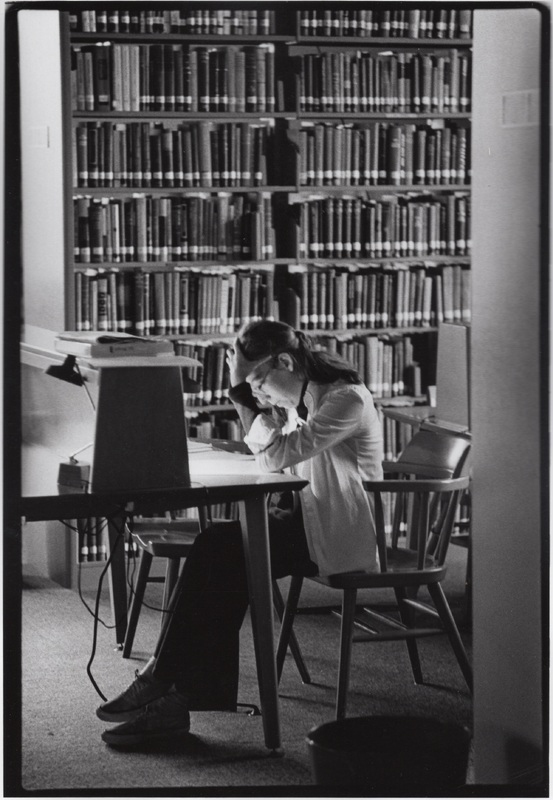
Students, Halcyon Hall Study, Bennett College, Millbrook, Dutchess, New York. c. 1907. Bennett College Collection.
“The [1893] catalogue of ‘Miss Bennett’s School for Boys and Girls’ gives insight into how progressive education reforms influenced Miss Bennett’s approach to education:
‘The aim of the school is the harmonious development of the three-fold nature of the pupil according to scientific principles: Mental development, not mere acquisition, growth, not accretion, strength acquired by self-activity, is the end earnestly sought, and every effort will be made to form habits of accuracy, self-control and self-reliance, and to inculcate a love of learning, a love of beauty, both of nature and of art, and a reverence for all that is good.’
‘Recent psychological investigations have revealed the importance of educating the motor nerve power. Thought and emotion are accompanied by an impulse to do something; to repress this physical impulse in a child produces fatigue, which reacts upon the mind and lowers its tone. To give this impulse normal expression, manual training becomes necessary, and in recognition of this fact clay modelling, mechanical drawing, painting and paper work form a part of the regular work of every grade.’
These words proved to be a grounding philosophy throughout the school’s 80+ year history, referenced repeatedly in the school’s catalogs and faculty handbooks for many years to come.
May Friend Bennett would hone her curriculum around this philosophy. Art, music, and physical education teachers were among her first hires on the school’s faculty. Field trips to art galleries and concerts were adopted as annual traditions. These traditions continued when Miss Bennett’s School for Girls opened in Millbrook with six forms (equivalent to today's high school grades 9-12 and the first two years of college) and 200 students ages 15-20.
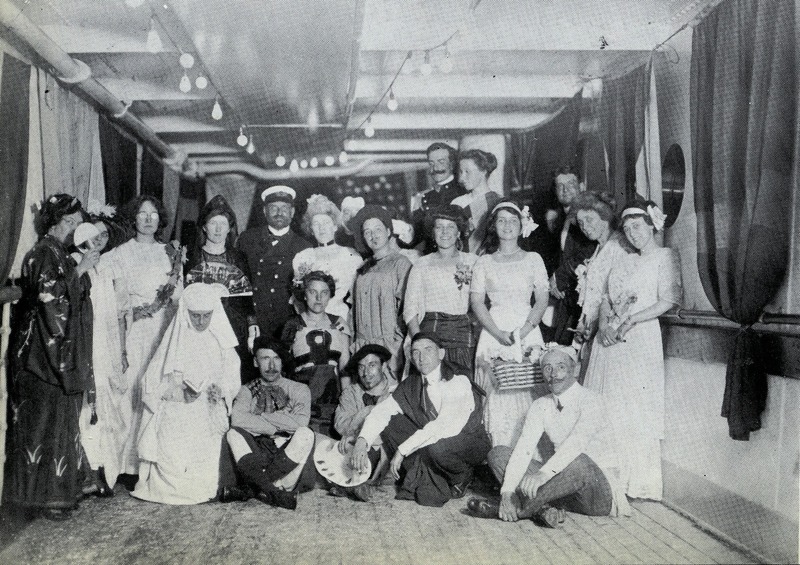
Captain's Dinner, Italy, 1910. Bennett College Alumnae Bulletin, September 1965. Bennett College Collection.

"The 1924 group on tour in England," England, 1924. Bennett College Alumnae Bulletin, September 1965. Courtesy of Mary Maar Pingry, Bennett College Collection.
In 1910, Miss Bennett introduced an innovative study abroad program for Seniors in good standing to spend the Fall term in Italy. A 1914 booklet describing the itinerary for the proposed trip outlines the premise of the program:
“A wholly American education… has its limitations. A girl has no everyday use for her foreign languages; the great pictures and statues are known to her only through copies, and her study of European history lacks the vividness and thrill which comes from seeing its setting.”
Feeling this limitation, and recognizing that to many American girls a diploma spelled “finished” instead of “begun”, Miss Bennett encouraged her students to travel and experience “the awakening only Europe can give.” In 1914, trips abroad were put on hold with the start of World War I, but resumed in 1921 when “Bennett girls joined Chaperone Nellie T. Sherwood on a fourteen-month trip around the world” - Bennett Bulletin, September 1965
Field trips and study abroad remained defining features of the Bennett curriculum.
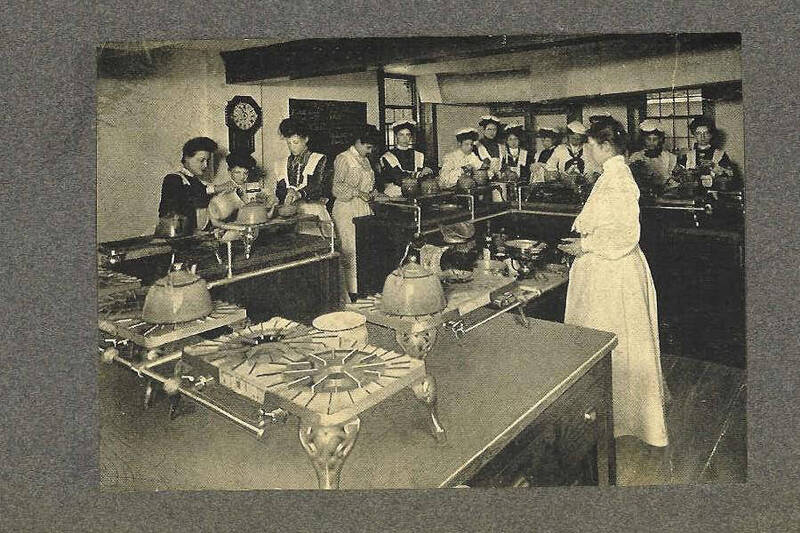
Through most of the school’s history, about half of Bennett students majored in liberal arts. May Friend Bennett was a pioneer in giving equal stress to fine and performing arts – music, dance, drama, paintings, and sculpture…[See: Theater and the Arts] The school also offered “courses in the practical arts including homemaking, child study, secretarial work, and overseas service - suiting these to the needs of changing times.”
The school’s second Principal and President, Courtney Carroll, oversaw its transition from a private institution to a non-profit 2 year college, governed by a Board. During Courtney Carroll’s tenure, the school’s fifth and sixth forms were officially recognized as a Junior College in 1935. In 1938, the trustees voted to discontinue the lower forms, and Bennett began operating exclusively as a two-year college, accredited by the Middle States Association. Bennett Junior College was the first two-year college in New York to have its curriculum approved by the State Board of Regents. In 1956, the college was authorized to grant Associates degrees in Art and Applied Science.
Miss Carroll is also credited with starting Bennett College’s Nursery School which opened in 1934 and offered Bennett students first-hand experience in the field of child study and early education. By the fall of 1938, the program had grown to occupy its own building, and in 1941 Rosemary Gannon was appointed Director of Child Study and the Nursery School. In 1963, the entire child study building was renovated and rededicated as the Mildred E. Purdy Child Study Center, complete with four nursery school units, a children's library, a creative arts studio, a kitchenette, and offices.

"Rosemary and children in the Nursery School when it was located in the present Student Center," 1936-1937. Bennett College Alumnae Bulletin, 1976. Bennett College Collection.
A 1957 catalog for Bennett Junior College shows May Friend Bennett’s continued influence on the school’s academic philosophy: “A college education for young women takes on added significance in a generation which is experiencing rapid and profound changes. More than ever, most women cherish and wish to conserve the abiding values of truth, freedom, justice and tolerance. These values may be found through the study of the liberal and creative arts.
Now, in accord with [May Friend Bennett’s] convictions, Bennett offers sound basic training in an unusually wide range of courses, both in the liberal arts and in the areas of the fine, applied, and practical arts.
Bennett students realize that in any age a sound cultural background is essential as a basis for personal development or for professional work. Many of them major in liberal arts, and some of these find time for work in the fine, applied, or practical arts. Others with particular talent devote a substantial portion of their working hours to the development of one of the arts, supplementing their work with related liberal arts courses. The aim of the College then is the development of mature citizens having an understanding and appreciation of the best of our cultural heritage and the ability to apply it creatively to their own times.”
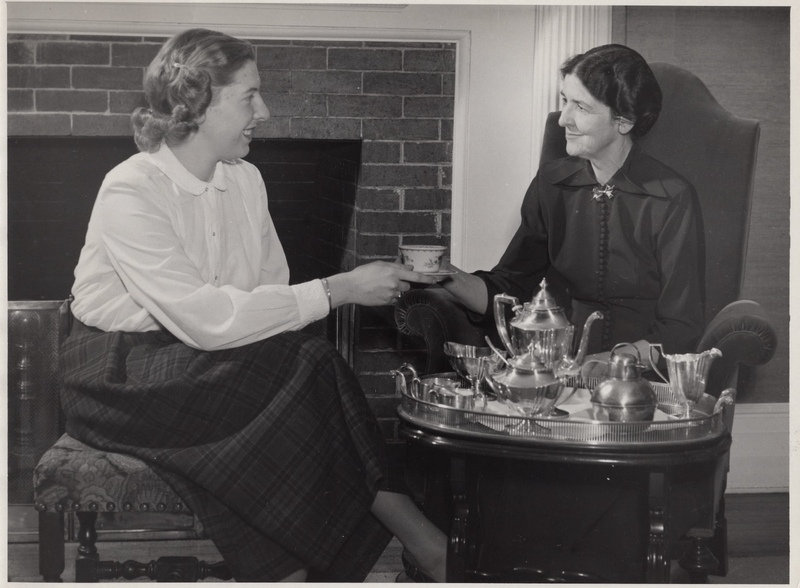
In 1957, Miss Carroll retired. Shortly before she left, the school changed its name once more - dropping “Junior” to become simply Bennett College.
Donald A. Eldridge’s, the College’s third President, began his tenure in 1957. He is credited with expanding the school’s arts programs with the opening of the Mellon Center for the Arts complex and introducing the popular Overseas Service Program, which included foreign languages taught by international faculty and a third year abroad for students to receive “on the job” training with an overseas organization.
With the opening of a state of the art Science Building on the campus in 1973, the school’s focus shifted to the goals of increasing enrollment and expanding offerings in the science department. A Bennett College catalog from 1974 lists the following offerings:
- Associate in Arts degree in Liberal Arts with majors expanded to include
- Behavioral-Social Science,
- English,
- Natural Science-Mathematics, and
- Liberal Studies.
- Associate in Applied Science degree with majors in
- Art,
- Child Study,
- Design,
- Horsemanship (a three year program), and
- Performing Arts (with a Dance, Drama, or Music Concentration).
The addition of a third year in the Overseas Service and Horsemanship program may reflect a growing demand for the school to expand to a four year college. Eldridge remained committed to the school’s two-year structure, listing the advantages: “Students have the satisfaction of completing a planned and balanced program, instead of the fragmentary experience of those who start but drop out of a four-year college as so many young women do. Students major in fields of special interest from the start of their college careers. They can also plan more flexible programs than are possible in many four-year colleges. Not only are students in closer touch with the faculty… but teaching is the primary job of the faculty, not just a part of it, as is so often the case in the four-year college or university.On graduation from a two-year college, the student has a wide choice of planning what to do next.” - Millbrook Round Table, May 12, 1966
Still, the pressure to expand may have influenced the school’s fourth President, Dr. Nystrom’s decision to partner with the New York Institute of Technology in 1976 to offer third and fourth year courses for Bennett students.
View additional records and images of Bennett College Academics here.
References:
Bennett Junior College 1957 Catalog, https://nyheritage.contentdm.oclc.org/digital/collection/p16694coll138/id/1317.
“Dedication: For College a New Step”, Millbrook Round Table, May 12, 1966.
Pingry, Mary M. “Her Influence Continues”, Bennett Alumnae Bulletin, Summer 1976.
“Yours Faithfully, Nellie T. Sherwood”, Bennett Alumnae Bulletin, September 1965.